Event reporting tools turn the data your event generates into dashboards and reports your team and leadership can act on. Most of them are built around registration and attendance. Program teams need more: how the call for papers is going, whether reviews are on track, which speakers haven't confirmed, and which sessions and topics performed.
This guide explains what program teams should look for in an event reporting tool and compares six options, including our own. We make Sessionboard, so weigh that entry accordingly.
What should program teams look for in an event reporting tool?
Program data, not just registration. Check whether the tool reports on submissions, review progress, speaker confirmations and tasks, and session content. If those live in another system, your reports will miss the part of the event you're responsible for.
Live data. Reports built from exports go stale the moment they're sent. Look for dashboards that update as the work happens.
Easy sharing. Committees, leadership, and sponsors need to see progress without logging into your platform or another status email.
Comparisons across events. Year-over-year and cross-event views show whether your program is improving.
Connections to your other systems. Your CRM, AMS, and registration platform hold the other half of the story. Reporting is far more useful when that data can flow together.
Our guide to event program KPIs covers which numbers to put on the dashboard once you've chosen a tool.
What are the best event reporting tools for program teams?
1. Sessionboard
Best for: program teams that need reporting on submissions, reviews, speakers and sessions
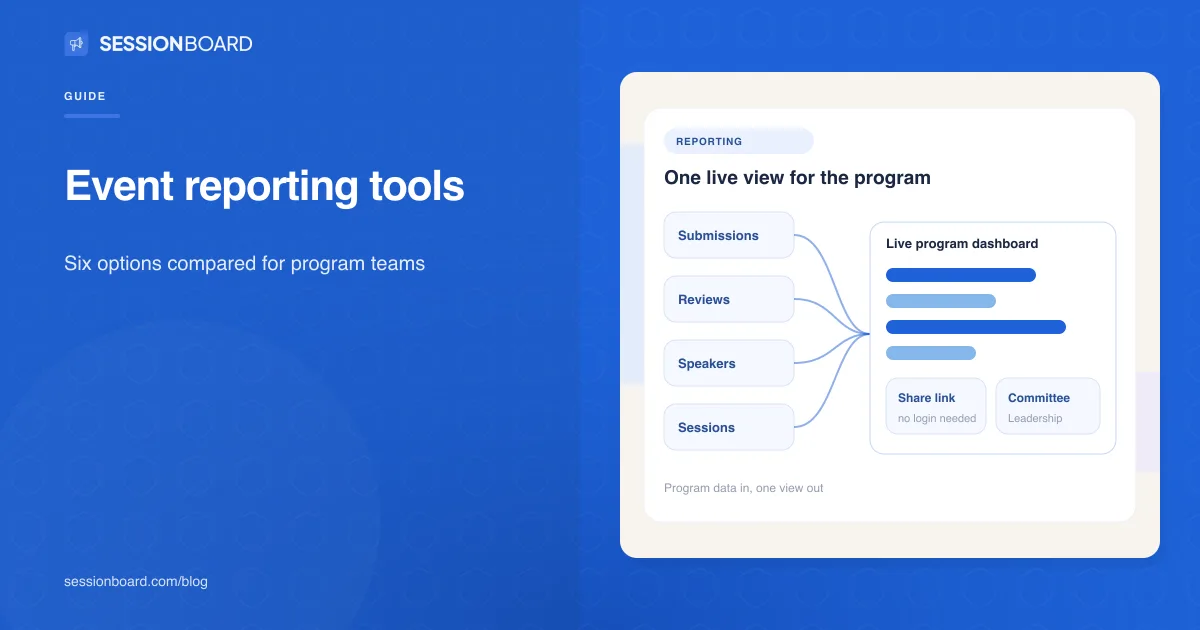
Sessionboard's reporting is built on the program itself. A live dashboard shows submissions, speakers, sessions, sponsors, exhibitors, and reviews in one place, with pre-built templates and public share links so leadership or a committee can view it live without platform access. Ready-made reports cover submissions pending review, sessions with speakers who haven't confirmed, and speakers with outstanding tasks or agreements. An AI report analyzes your session catalog to find topics that are over-covered, thin, or missing.
Consider: Sessionboard focuses on content, speakers and the program. Registration reporting comes from your registration platform through integrations.
2. Cvent
Best for: large organizations that want registration, attendance, and ROI reporting across an event portfolio
Cvent's event reporting offers built-in dashboards covering registration trends, check-ins, session attendance and engagement, with CRM connections to tie events to pipeline and revenue. It supports comparisons across events, regions, and teams, role-based access, and AI summaries of session feedback and surveys.
Consider: it's strongest where Cvent also runs registration and the event itself.
3. Bizzabo
Best for: event marketing teams tracking engagement and sponsor results
Bizzabo's analytics cover check-ins, session attendance and ratings, mobile app usage, and post-event surveys in a centralized dashboard that updates in real time and can be shared inside or outside the organization. Bizzabo also emphasizes measuring sponsor value.
Consider: reporting focuses more on attendee engagement than on the call for papers and review process.
4. Swoogo
Best for: registration-led teams that want flexible, shareable reports
Swoogo Analytics tracks the attendee journey from site visit to registration, with pre-built and custom reports on registrations, sessions, speakers and sponsors. Reports can be shared by link or sent automatically by email, cross-event reports compare performance year over year, and integrations with Salesforce, HubSpot and Marketo carry data down the funnel.
Consider: speaker and session reporting depends on how much of your program runs in Swoogo.
5. Cadmium (Eventscribe)
Best for: associations already running events and education on Cadmium
Eventscribe includes real-time registration analytics, post-event analysis and ROI tracking as part of its association event suite, alongside credit management.
Consider: Cadmium's public pages describe registration and post-event reporting, with little detail on reporting for abstracts and review.
6. A BI tool such as Looker Studio or Power BI
Best for: teams with analysts who want to combine event data with other business data
General business intelligence tools can pull in exports or connected data from your event platforms, CRM and AMS and build any dashboard you design.
Consider: someone has to build and maintain the connections and dashboards, and the reports are only as current as the data feeding them.
How do you choose the right event reporting tool?
Start with where your program data lives. If submissions, reviews and speakers are managed in one platform, report from there and pull registration in through integrations. If registration is your main concern, your registration platform's reporting may be enough. If you need to combine many systems, add a BI tool on top. Then check who needs to see the reports, and make sure they can, without another login.
Best event reporting tools for program teams, answered
What is an event reporting tool?
An event reporting tool turns event data, such as registrations, attendance, sessions, speakers and feedback, into dashboards and reports that teams and stakeholders use to make decisions.
What should event program teams report on?
Submission volume and topic coverage, review completion, speaker confirmations and outstanding tasks, session attendance and ratings, and the outcomes the program drives, such as education credits, content revenue and member retention.
Can I share event reports with people who don't use our platform?
Many tools now support it. Sessionboard dashboards have public share links, Bizzabo dashboards can be shared outside the organization, and Swoogo reports can be shared by link or emailed automatically.
Do I need a BI tool like Power BI for event reporting?
Not always. Built-in reporting covers most program and registration needs. A BI tool helps when you need to combine event data with data from many other systems and have someone to maintain it.
How often should program teams review reports?
Weekly while the call for papers, review and speaker confirmation are under way, and at set points after the event for attendance, feedback and outcomes.
What's the difference between event reporting and event analytics?
Reporting shows what happened, such as registrations or review progress. Analytics goes further to explain why and what to do next, such as which topics drew demand or where your program has gaps.
Running your program on spreadsheets and status emails? See how Sessionboard reports on submissions, reviews, speakers and sessions in one live view. Request a demo →