
July 28, 2026

3
min read
FAQ: Managing CME and credit deadlines across a multi-track program
Structured FAQ , CME credit deadlines, multi-track ownership, and when to tag sessions.


Structured FAQ , CME credit deadlines, multi-track ownership, and when to tag sessions.
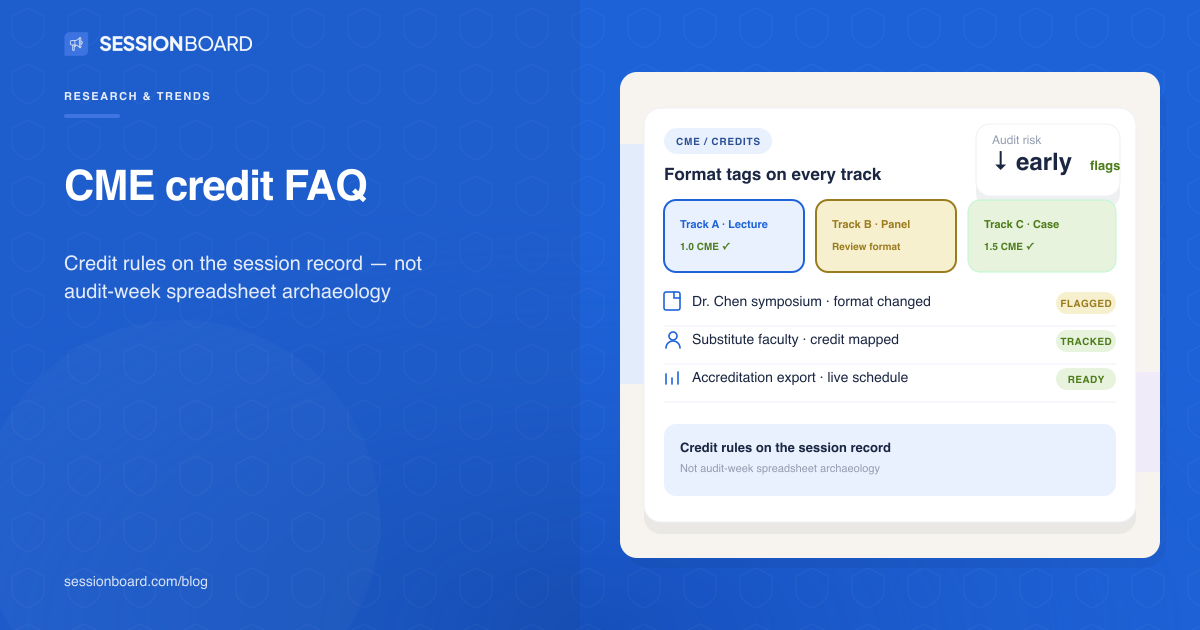
Your ACCME auditor does not care that the keynote ran long or that Track C lost its discussant. They care whether each named session still matches the credit rules you attested to months ago — and whether you can prove it.
Multi-track med/sci programs multiply the risk: parallel owners, last-minute swaps, and format tags that never traveled from abstract acceptance to the scheduler.
Credit deadlines are operational, not compliance afterthoughts. Attach requirements when format and role are known at acceptance; flag conflicts when the schedule moves; export attestations from live session state — one record from CFP through delivery.
Med/sci congress: Dr. Chen's symposium moves from lecture to panel discussion — credit impact surfaces before the program book ships, not when certificates generate.
Association CME workshop: Chapter meetings run parallel tracks with different credit categories — each session carries format tags from acceptance through scheduling.
Corporate medical affairs summit: Internal compliance reviews credited sessions against live roster — substitute faculty trigger alerts while materials collection is still open.
Treat credits as data on the program record, same as speaker and room. Sessionboard's credit engine connects requirements to live session state so directors see risk early.
Deep dive: The credit hour nobody tracked until audit week
Program ops owns schedule truth; accreditation owns attestation rules — both need one session record with format tags and roles.
At acceptance, when format and speaker role are known — not after scheduling or during audit prep.
Rules on the session record flag when schedule changes invalidate format — track owners see impact before delivery.
Share on LinkedIn? Paste FAQ answer #1 — credit deadlines fail when format tags and schedule live in different tools. One session record from acceptance through audit.


Stay up to date with our latest news

A step by step guide to running a poster session.
The KPIs that show whether your event program worked.
See how real teams simplify speaker management, scale content operations, and run smoother events with Sessionboard.
