
July 30, 2026

3
min read
The credit hour nobody tracked until audit week
ACCME credit rules live in spreadsheets until audit week — then the gaps show up fast.


ACCME credit rules live in spreadsheets until audit week — then the gaps show up fast.
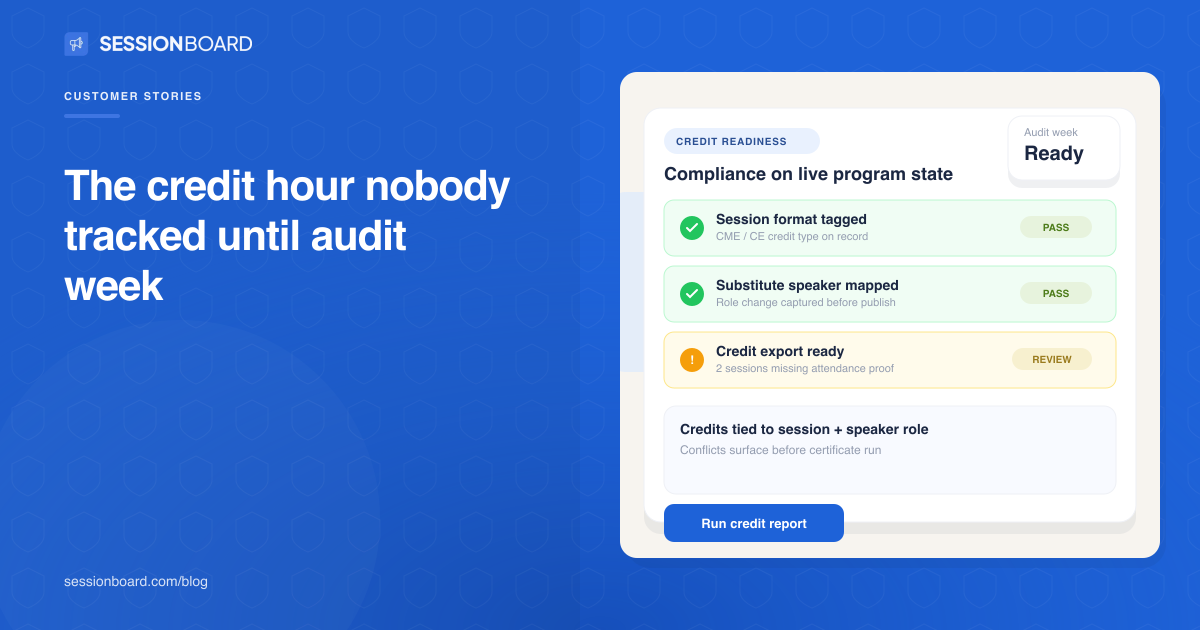
Your ACCME auditor does not care that the keynote ran long or that a speaker swapped slides at the last minute. They care whether each named session still matches the credit rules you attested to months ago, and whether you can prove it.
Most program teams I meet still hold that proof in pieces: the abstract tool, a scheduling spreadsheet, the accreditation consultant's inbox, and a folder of signed attestations nobody opened since March.
We had a customer success call last year that started with "we found a credited session that never got a format tag." Audit was six weeks out. That one gap turned into a week of rework.
Credit rules live on the same program record as the session, speaker, and materials. When the schedule changes, the credit impact shows up while you can still fix the program, not after badges print.
Teams that pass audit without a fire drill treat credits as operational data, not a compliance afterthought:
Sessionboard's credit engine connects requirements to live session state so program directors see risk early.
Rules depend on format, role, and timing spread across tools. Manual tracking surfaces conflicts too late.
Only if schedule and speaker state sync both ways. Otherwise reviewers approve under one set of assumptions and accreditation runs under another.
Confirm every credited session matches its format tag, every substitute is mapped, and every parallel track has an owner who signed off on requirements.


Stay up to date with our latest news
The KPIs that show whether your event program worked.
See how real teams simplify speaker management, scale content operations, and run smoother events with Sessionboard.
