
July 28, 2026

3
min read
How to manage abstract submissions for your conference (2026 guide)
A practical 2026 guide to managing conference abstract submissions — policy, forms,…


A practical 2026 guide to managing conference abstract submissions — policy, forms,…
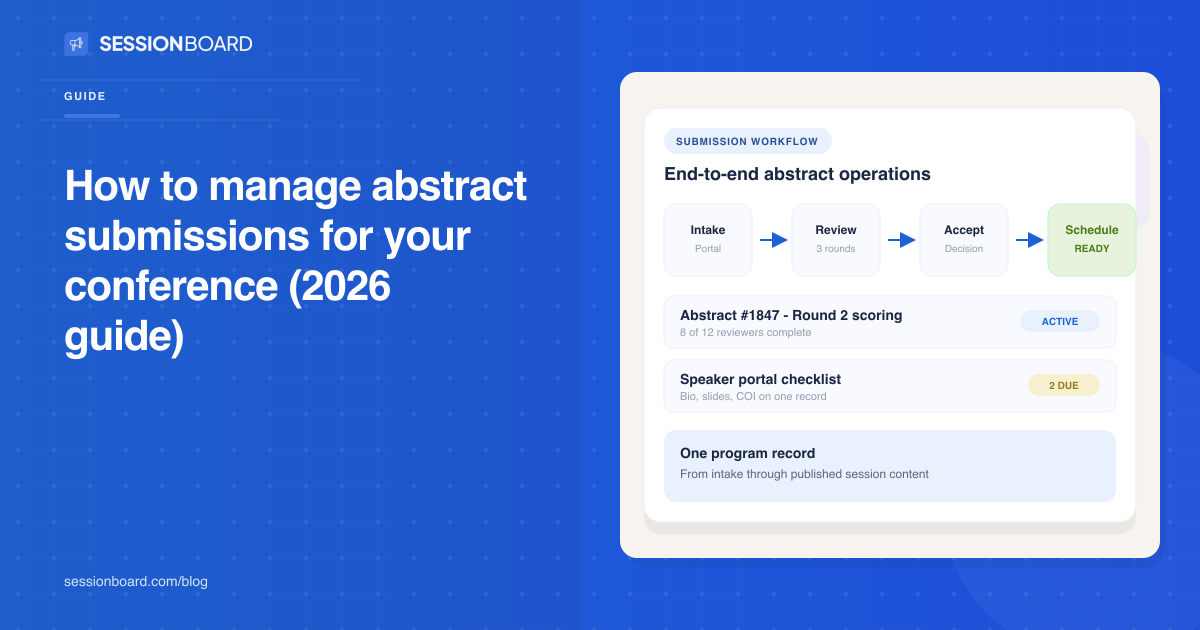
Abstract submission is not a web form. It is the program operating system. Every field you ask authors to complete becomes data reviewers, chairs, schedulers, and accreditation staff need later.
When that data lives in email attachments and shared drives, you pay in duplicate reviews, missed conflicts of interest, and program changes nobody can trace.
This guide walks through what associations and med/sci conferences run in 2026, and where specialist abstract software beats a general event suite.
Before authors see a login screen, document:
Clear policy beats UI polish for support ticket volume.
Every field should answer a question someone asks after acceptance:
| Field | Used by |
|---|---|
| Session format preference | Program committee + scheduler |
| Track / topic | Reviewer routing |
| Author order & presenting author | Badges, credits, session listings |
| Learning objectives (med/sci) | Accreditation export |
| Equipment / AV needs | Ops and room assignments |
Skip "nice to have" fields at submission time. Collect poster dimensions and copyright releases at acceptance, when authors are motivated to comply.
Committee burnout is the hidden tax of abstract season. Good routing looks like:
If reviewers work in PDFs attached to email, you lose audit trails. Scores should live on the submission record.
When chairs finalize decisions:
Large medical programs show most volume in the last 48 hours. That means:
Acceptance is not the finish line. Winners still need final abstract text, bios, headshots, session placement, and credit mapping (med/sci).
Specialist platforms keep the submission ID attached as the session moves from review to schedule to website to credits. Suite tools often break that chain at export time.
Sessionboard is for teams where abstracts, speakers, sessions, credits, and awards share one program record. If you are comparing Cadmium, OpenWater, or a suite module, look at surge handling, whether schedule changes flow back to abstract metadata, and med/sci credit exports without a second reconciliation.
See Sessionboard vs Cadmium for complex program workflows.
Authors submit through a portal; staff validate eligibility; reviewers score; chairs decide; accepted authors confirm and upload finals before the program locks.
Six to ten weeks is typical. Plan operations for a final-week surge, not average daily volume.
Fine for small programs. Reviewer blinding, COI enforcement, and schedule linkage break quickly above ~200 submissions.


Stay up to date with our latest news
The KPIs that show whether your event program worked.
See how real teams simplify speaker management, scale content operations, and run smoother events with Sessionboard.
