
August 3, 2026

3
min read
When most of your abstracts arrive in the final 48 hours
Most med/sci abstracts land in the final 48 hours. What breaks and how teams prepare.


Most med/sci abstracts land in the final 48 hours. What breaks and how teams prepare.
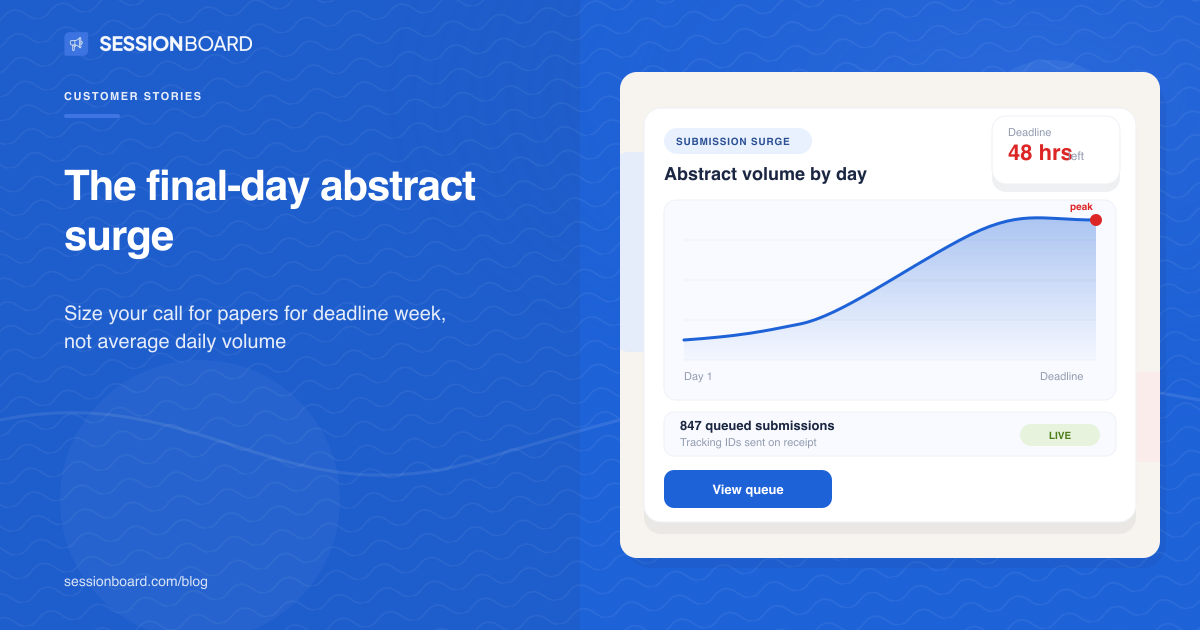
Your call for papers opened eight weeks ago. Week one: a trickle. Week six: still quiet. Then, forty-eight hours before cutoff, the portal becomes the most visited site your organisation runs.
Large society programs processing thousands of abstracts per cycle often see 60–90% of submissions in that final window. It is not just procrastination. Faculty batch writing around clinic schedules, co-author delays, and grant deadlines all compress work into the last viable hour.
If your stack was sized for average daily volume, deadline week is when it fails: duplicate submissions, lost PDFs, reviewers asking which version is final, staff answering the same login question until midnight.
Hard failures at 11:58 PM are unacceptable across time zones. You need idempotent submits, retry-safe uploads, and a clear confirmation with a submission ID, not a spinning wheel.
Any step that requires staff to touch a row before the author sees success builds a queue faster than your team can clear. Eligibility rules belong in automated checks with plain error messages.
"We emailed the final version" does not scale when forty co-authors reply-all with attachments. The portal version has to win.
Chairs cannot wait until deadline plus three days to assign reviewers if the decision calendar already assumes four weeks of scoring. Surge-aware teams pre-stage reviewer pools by track before deadline day.
Infrastructure for spikes, not averages: load test the submission path, keep uploads from blocking the thread, give admins queue depth not just totals.
Support rota for deadline week: FAQ macros, timezone coverage, one status page. Launch-week staffing is vanity. Deadline-week staffing protects registration tied to program credibility.
One submission record: when abstract #4821 becomes Session 14B, every change traces to the same ID. Re-keying after deadline inherits errors nobody catches before the app publishes.
A multi-track medical association processing several thousand intakes per annual meeting saw:
After one program record, automated track validation, and surge-safe acknowledgements, the same team held deadline week with half the volunteer hours and started review assignments 48 hours earlier.
Numbers vary by society. The pattern does not.
Deadline surge predicts program risk. If intake breaks under load, final materials break under the same pressure. Late reviewer starts slip acceptance letters. Re-keyed data poisons credit exports. Med/sci teams feel that in audit prep, not just IT tickets.
We treat abstract intake as part of the live program graph, same record as sessions, speakers, credits, and website content:
We are built for teams where abstract week is production season, not a side form.
Authors optimize revision and co-author time. Med/sci faculty especially batch work against hard cutoffs.
Queued submits, tracking IDs, deadline-week support, automated validation instead of manual gates.
Submit under load, large file upload, timezone cutoff behavior, reviewer assignment the day after deadline.


Stay up to date with our latest news
The KPIs that show whether your event program worked.
See how real teams simplify speaker management, scale content operations, and run smoother events with Sessionboard.
