
July 28, 2026

3
min read
How event software pricing actually works for content-heavy conferences
Per-registrant vs per-event vs modules , what content-heavy conferences actually pay for.


Per-registrant vs per-event vs modules , what content-heavy conferences actually pay for.
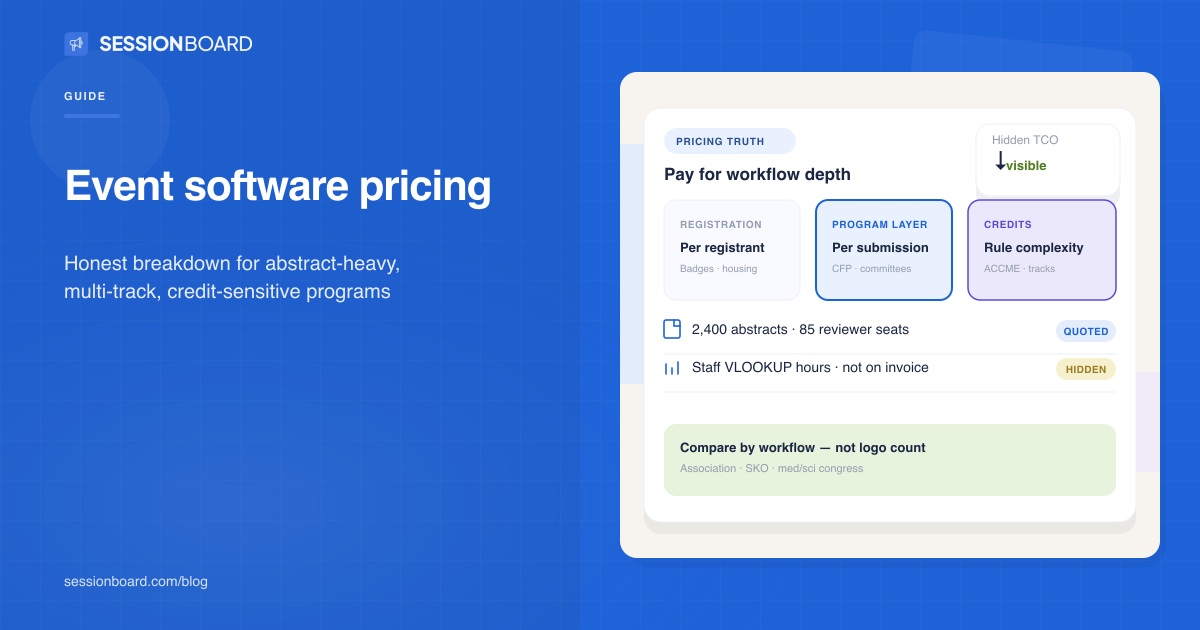
The RFP asks for one number. The contract arrives with per-registrant fees, module add-ons, implementation hours, and a line item nobody explained for "content services."
Content-heavy conferences , med/sci congresses, association annual meetings, multi-track corporate summits , rarely fit a single SKU.
Pricing follows complexity. Registration vendors price badges and housing. Program depth , abstracts, committees, credits, awards, speaker materials , drives cost in the layer that actually runs your content. Compare quotes by workflow, not logo count.
Transparent line items tied to jobs:
| Job | Typical owner | Pricing signal |
|---|---|---|
| Tickets, housing, badges | Registration vendor | Per registrant / per event |
| Abstracts, review, scheduling | Program layer | Submissions, tracks, seats |
| Credits / CME attestation | Program + compliance | Rules complexity, exports |
| Awards / nominations | Program layer | Categories, judges, cycles |
| Content marketing / advocacy | Content platform | Advocates, assets, attribution |
Finance and program can defend the stack because each dollar maps to a workflow.
Association: 2,400 abstract submissions, 85 reviewers, gala awards , the quote should reflect submission volume and committee seats, not attendee headcount alone.
Corporate SKO: 120 sessions, 40 internal SMEs, strict brand review on speaker materials , pricing follows speaker workflows and content collection, not expo floor square footage.
Med/sci congress: ACCME credit rules on 60 parallel tracks , cost tracks credit engine complexity, not generic "event management."
Read: When you need a program layer, not another EMS · Speaker content when registration won the RFP
Bundled suites mix registration, abstracts, and apps , quotes hide program complexity behind per-registrant math.
Abstract volume, committees, tracks, credits, awards, speaker workflows , not badges alone.
Often for complex programs: pay for depth where content lives; keep registration in place.
Share on LinkedIn? Lead with the quick answer , content-heavy conferences pay for abstracts, committees, and credits, not badge scanning. Compare quotes by workflow.


Stay up to date with our latest news

A step by step guide to running a poster session.
The KPIs that show whether your event program worked.
See how real teams simplify speaker management, scale content operations, and run smoother events with Sessionboard.
