
★★★★★
“Sessionboard has been one of our most successful investments this year, making our team more efficient and allowing us to focus on the most critical components of our events.”

Committee ops and speaker readiness on one graph — registration stays where it is.
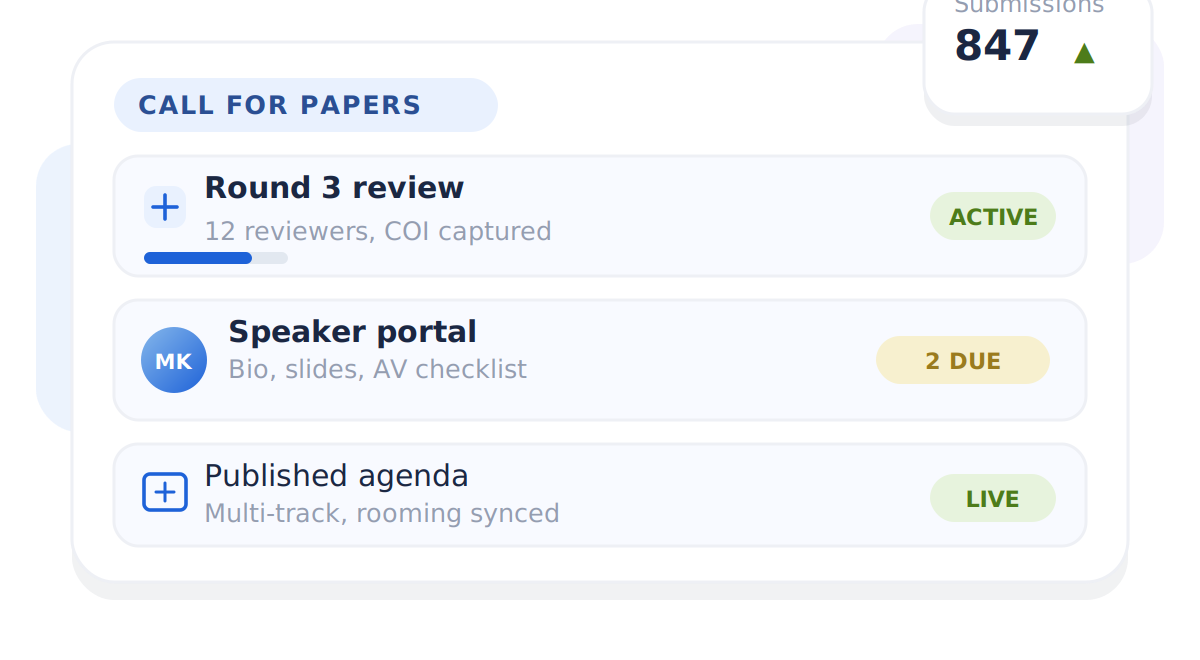





Sessionboard is abstract submission software plus everything after: call for papers, multi-round review, chair workflows, conflict of interest capture, speaker portal, and program build for multi-track medical and scientific events. Registration and ticketing stay on Cvent, Cadmium, RainFocus, or your AMS — Sessionboard owns the eight weeks between abstract acceptance and doors open.
Match your role to the job Sessionboard solves — program ops, content reuse, or marketing attribution.
Review rounds coordinated in email — you need rubrics, COI capture, and chair assignments without opening a vendor ticket.
Bios, headshots, and slides chased in spreadsheets — you need a speaker portal tied to acceptance state.
Agenda conflicts discovered late — you need program build on the same graph as review decisions.
Faculty data exported twice each cycle — you need sync paths to Cvent or Cadmium, not duplicate entry.
“Sessionboard has been one of our most successful investments this year, making our team more efficient and allowing us to focus on the most critical components of our events.”

“Sessionboard saves significant planning time and makes it easier than ever for speakers and sponsors to participate in our clients' events.”

“We used Sessionboard daily. It served as our source of truth for tracking speakers, sending emails, and accessing reports. The ability to set a weekly digest email was a huge time saver.”
“Honestly, I loved it! Getting everything out of the spreadsheet. It collects all the information and gives you a visual of who you might want to invite.”
Registration suites excel at tickets and badges. Program committees still live in email, PDFs, and spreadsheets between acceptance and show day.
See how Sessionboard fits beside your existing stack.
One system for reviewers, chairs, speakers, and agenda state — synced beside your registration stack.
Multi-track congresses with formal review — not single-room staff meetings.
500+ abstracts, 50+ reviewers, accreditation context — committee pain leadership already recognizes.
Multi-track programs where registration is enterprise-grade but speaker chase is still manual.
Formal peer review, poster and platform formats, and faculty identity across recurring meetings.
Investigator meetings and advisory boards with compliance-friendly review audit trails.
Chairs, rubrics, and COI in the product — not forwarded PDFs after round two.
Materials and communications tied to acceptance — what makes program publish possible.
Customers run beside major registration platforms — program depth without replacing tickets.
Program operations beside registration — not a rip-and-replace migration.
Yes — and that is the front third of it. Authors submit through custom forms, reviewers score in multi-round blind workflows with COI checks, and then acceptance flows into speaker portal, materials, and program build. Submission-only tools stop at the decision; Sessionboard runs the whole cycle on one record.
Usually not. Sessionboard owns call for papers, review, speaker ops, and program build. Registration, badges, and housing stay on Cvent, Cadmium, RainFocus, or your AMS.
Multi-round workflows with chair assignments and scoring rubrics are core — built for medical and scientific committee calendars, not single-pass submission tools.
Program teams need self-service CFP and review configuration — not a ticket queue for every field change during an open call for papers.
Reviewer COI capture and assignment rules are part of committee workflow — critical for accredited medical meetings.
Sync and export paths depend on your stack — see works-with guides for Cvent, RainFocus, and other platforms. The goal is one faculty record in Sessionboard, not double entry.
Virtual and hybrid sessions use the same abstract and speaker graph — webinar runtime is documented separately on works-with pages.
Single-track internal meetings under 50 speakers with no formal review rarely need a program layer. Add Sessionboard when committee pain is unprompted in leadership meetings.
Talk through your event workflow — abstracts, speakers, content, and marketing on one program graph.
Editorial guides from the Sessionboard blog.
 Learn
Learn
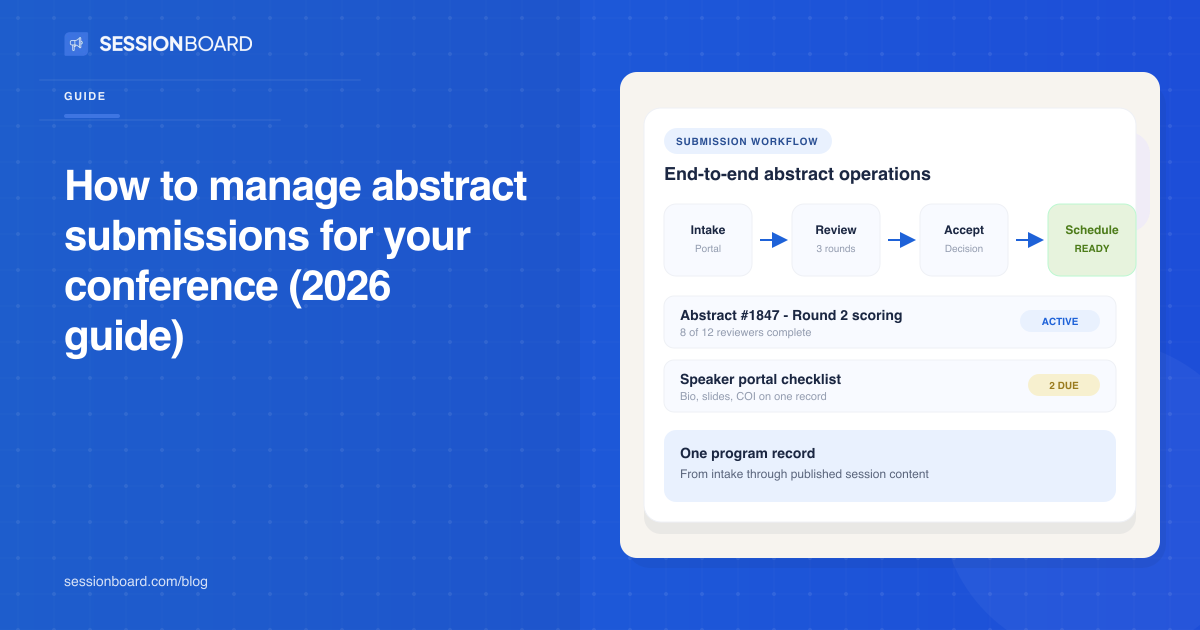
A practical 2026 guide to managing conference abstract submissions without spreadsheet chaos.
Read article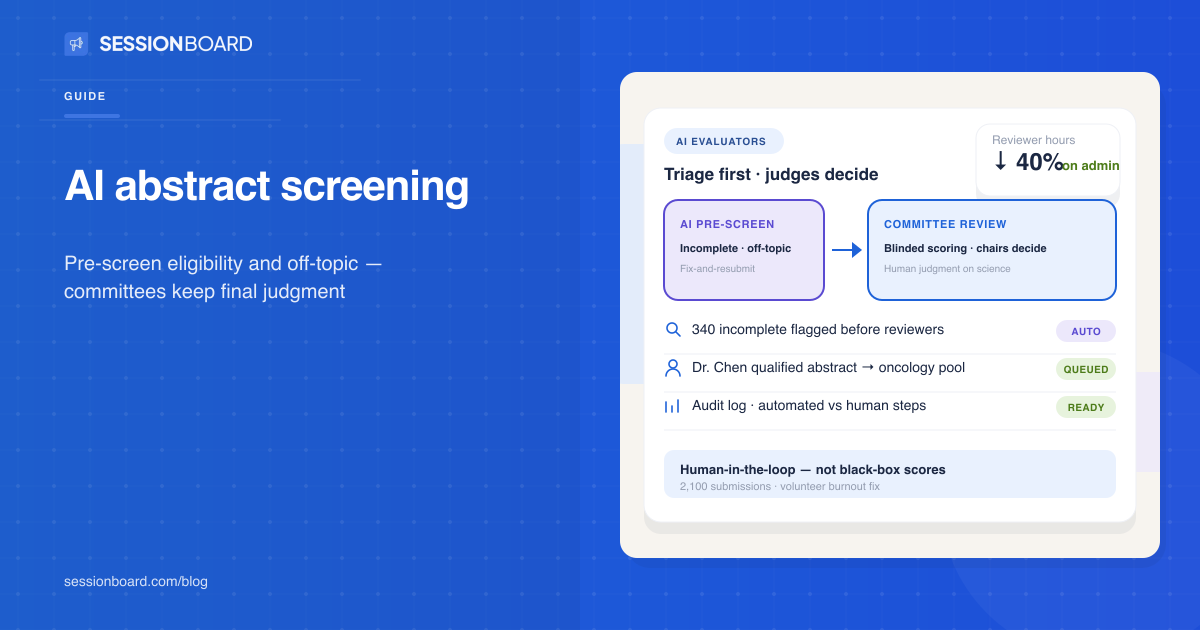 Learn
Learn
AI triage for abstracts — not replacing committees, saving volunteer hours.
Read article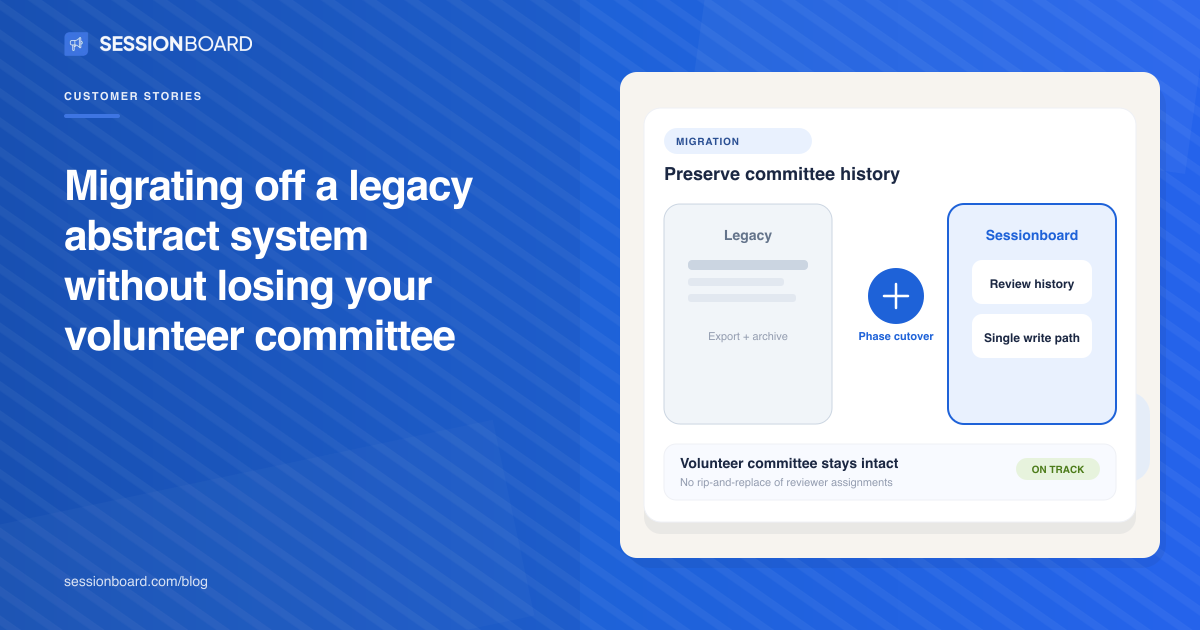 Story
Story
Migrate off a legacy abstract system without losing your volunteer review committee.
Read articleRunning a complex call for papers this cycle?
Request a demo