
August 3, 2026

5
min read
Sponsor amplification that survives the renewal call
Sponsor packages promise amplification. Per-partner tracked links turn that promise…


Sponsor packages promise amplification. Per-partner tracked links turn that promise…
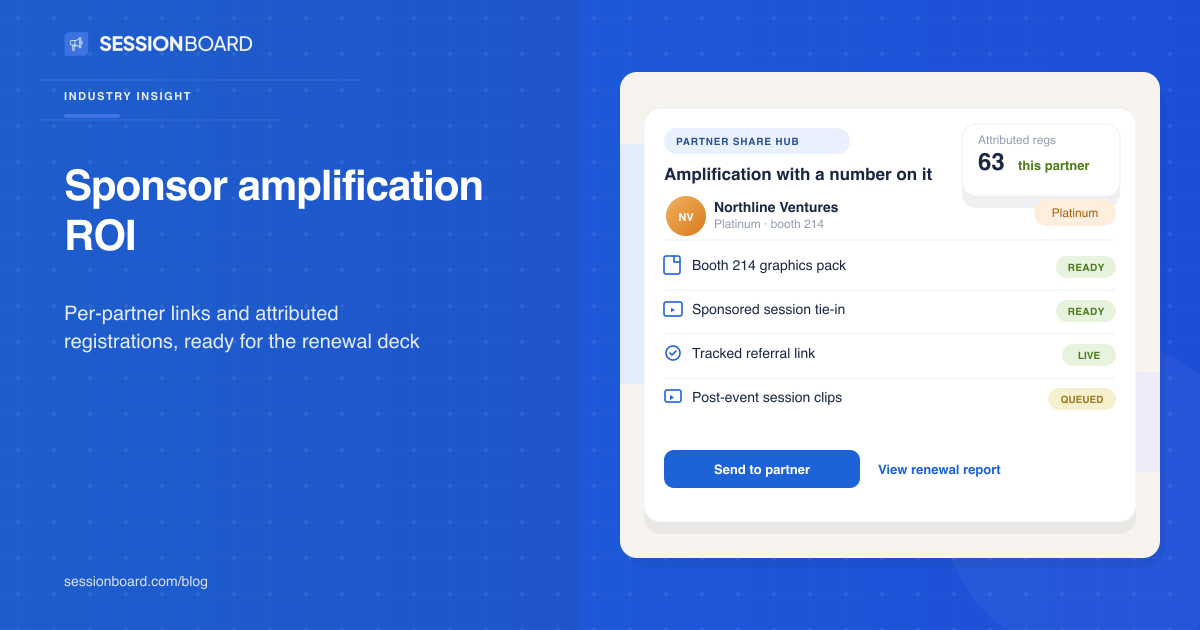
Renewal season, and a sponsorship manager is assembling proof. The package sold last spring promised amplification: logo placement, social mentions, "extended reach across our channels." What exists as evidence is a folder of screenshots. A LinkedIn post with the sponsor tagged. An email banner. A photo of the booth with decent foot traffic behind it.
The sponsor's marketing lead looks at the collage and asks the only question that matters to her budget: how many registrations did any of this produce?
Nobody knows. So the renewal conversation falls back to booth traffic and gut feel, and the package price holds only as long as the relationship does.
Exhibitors and sponsors don't buy posts. They buy access to an audience that trusts you, and they were promised that some of your promotional machinery would point at them. Two things break that promise in practice.
The first is friction on their side. The person at the sponsor who would share your event is a field marketer with nine other properties on her plate. She has no graphic with her company's booth number on it, no draft post, and no reason to invent one. The mention you hoped for never ships, and it isn't because she didn't care.
The second is that nothing closes the loop even when sharing happens. The sponsor posts, someone clicks, a registration comes in through the generic link, and your registration report credits "social." The one piece of evidence that would have anchored the renewal is gone the moment it was created.
The fix is structural. Every partner gets their own tracked link the day their package goes live, and every asset they receive carries it.
That single change does three jobs:
Partners who can watch their own number climb keep sharing. That feedback loop is the part the screenshot collage never had.
A partner asset sent once at contract signing goes stale by the time the audience is deciding. The shares that convert follow program milestones, because each milestone gives the partner something new to say:
| Program moment | What the partner receives | Why it lands |
|---|---|---|
| Package goes live | Share hub, booth graphics, tracked link | Peak partner enthusiasm, contract just signed |
| Agenda publishes | Updated graphic with sponsored sessions and floor location | New news for their audience, second share unlocked |
| Early-bird deadline | Deadline copy with their referral link | Urgency plus attribution in one post |
| Event week | "Find us at booth 214" assets tied to live sessions | Reaches attendees finalizing their plans |
| Post-event | Clips and quote cards from sponsored sessions | Proof for the audience that missed the room, content for the partner's own pipeline |
In Sessionboard this sequence runs off program state. Advocacy fires the partner hub when the package record goes live, the Advocacy Agent sends the refreshed asset when the agenda publishes and re-nudges partners who went quiet, and post-session clips land on the same partner page after transcription. Speakers, attendees, and internal teams via Dispatch run on the same attribution layer, so the marketing director sees every advocate type in one rollup.
Sponsorship teams that run per-partner attribution walk into renewals with a different artifact. Instead of the collage, the deck shows each partner's attributed registrations, their share activity by milestone, and how their number compares to the package tier. Underperforming partners get a mid-cycle nudge while there's still time to fix it, rather than a surprise at renewal.
It also changes what you can sell. Amplification stops being a soft line item and becomes inventory with a track record: last year's platinum sponsors averaged a measurable registration lift, and that number is now part of the pitch for next year's prospectus.
Snöball, Gleanin, and InGo are good at referral campaign UX when your roster lives in a registration export. Many teams keep one of them for attendee campaigns and run partner amplification from the program graph, where the sponsor package, booth assignment, and sponsored sessions already live. The works-with guides cover the coexistence patterns.
Remove the blank page. When a package goes live, hand each partner a share hub with their booth number, session tie-ins, pre-written posts, and a tracked registration link. Partners share when the asset takes under a minute and the link proves what their post produced.
Give every partner their own tracked link and count registrations against it, not impressions. When share, click, and registration sit on the same partner record, the renewal deck shows attributed signups per sponsor instead of screenshot collages.
A partner share hub, personalized graphics with booth number and any sponsored sessions, pre-filled post copy, a tracked referral link, and a fresh asset at each milestone: package live, agenda publish, early-bird, and post-event clips from sponsored sessions.
They should. A partner who watches registrations accrue against their link keeps sharing, and the number becomes the anchor of your renewal conversation instead of a reach estimate.
Yes. Teams run Sessionboard for program and partner state and a specialist P2P tool for referral campaign UX. Coexistence works when attribution and the partner record live on the program graph.
Peer-to-peer event marketing on Sessionboard · Speaker advocacy guide · Request a demo


Stay up to date with our latest news

.png)
More than 60% of associations are diversifying revenue, per ASAE. The fastest new…
See how real teams simplify speaker management, scale content operations, and run smoother events with Sessionboard.
