
August 3, 2026

3
min read
The poster hall that stays open all year
Printed posters come down Sunday. An ePoster gallery that stays open turns one weekend…


Printed posters come down Sunday. An ePoster gallery that stays open turns one weekend…
Teardown starts before the last session ends. Volunteers pull pins, authors roll their posters into cardboard tubes, and by early evening the hall is carpet and empty boards. Eight months of submissions, review calls, and author wrangling produced a body of research that existed, as a collection, for about forty hours.
A membership director at an engineering society put it plainly: the annual meeting accepts around seven hundred posters, and by Monday she could not point a member to a single one of them. The society's website had the abstract titles. The research itself went home in the tubes.
ePosters were supposed to fix this, and sometimes they half do. Plenty of poster platforms are scoped to the event: the gallery runs meeting week, maybe a grace month, and then the contract ends and the link dies. The posters survived the hall and then hit the invoice.
Look at what that poster collection contains before it disappears. Hundreds of studies, screened by your own committees, from the exact community your members belong to, on the topics your field will argue about next year. Commercial publishers charge for access to content like this. Associations produce it annually and then let it evaporate.
Kept open, the same collection works three jobs.
Member value between meetings. The eleven months separating annual meetings are when membership value is hardest to demonstrate and renewal decisions actually happen. A searchable gallery gives a member a reason to come back in February: the resident preparing a journal club, the clinician checking what came out of the meeting she skipped, the committee member scanning what last year's accepted work looked like before writing this year's call. Each visit is the association delivering its core promise, access to the field, with content it already paid to collect.
A recruiting surface. Prospective members and prospective submitters can see the science, and authors accelerate this themselves. An author with a durable link and a share kit posts her own poster to her own network, and her network is precisely the population most likely to submit next year. Work that lives only in a tube markets nothing.
Institutional memory for the program. Multi-year galleries compound. Five annual meetings in one searchable library is a research archive that starts to look like a member benefit worth naming in the renewal letter.
There's a second thing the persistent gallery produces, and it may matter more than the archive: evidence.
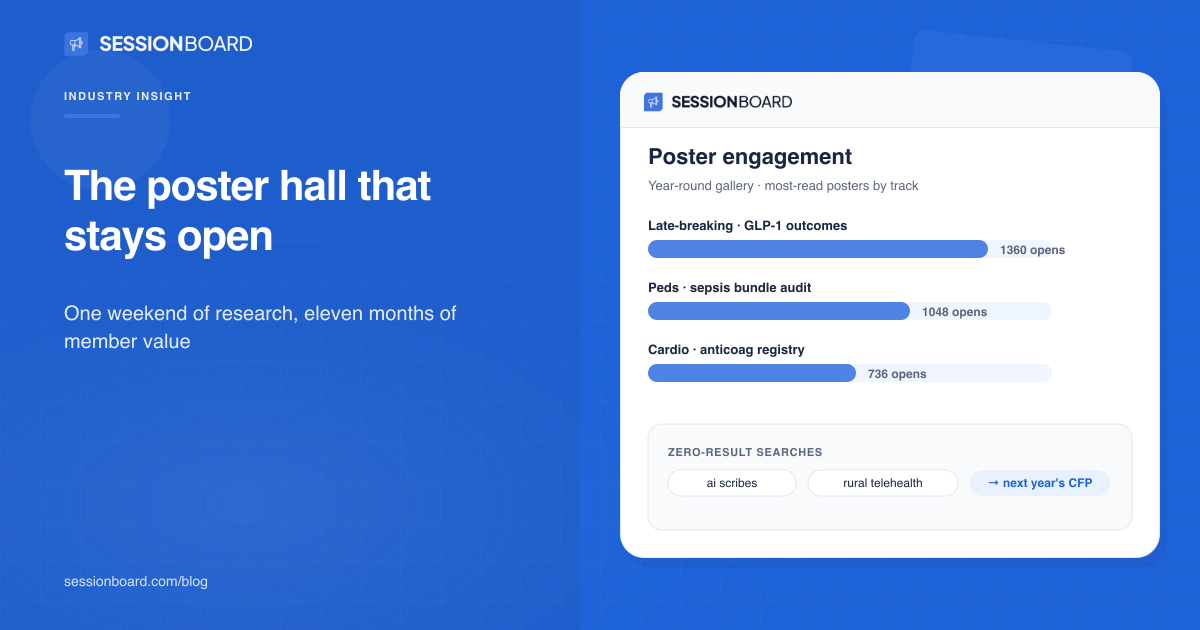
Program committees mostly fly blind on posters. They know submission counts and acceptance rates. What they don't know is what happened next: which posters got read, which tracks held attention, which authors fielded questions. A gallery that stays open generates exactly this. Reading time by track. Author question volume. Most-opened posters, and how long people stayed.
The sharpest signal is the search log, specifically the searches that returned nothing. A member who searched the gallery for a topic and found no posters just told you, in her own words, what she wanted from your program and didn't get. A season of zero-result searches is a ranked list of gaps, waiting to shape the next call for papers. No survey produces data that honest.
Not much, if the posters were collected properly in the first place, and quite a lot if they weren't. The gallery needs publication consent gathered at upload, because you cannot publish posters year-round on permissions you never collected. It needs disclosures displayed and withdrawn work excluded automatically, because an archive with compliance holes is a liability rather than a benefit. And it needs to live on the association's own brand and domain, because a member archive that dies with a vendor contract is the problem restated, not solved.
This is the design behind Sessionboard's Poster Gallery: posters flow from the call for papers with consent and disclosures attached, publish to a searchable gallery on one link, and stay there, with the analytics accruing to the association rather than to a platform you'll leave someday.
The meeting is a weekend. The research your members produced for it doesn't have a natural expiration date, and there's no reason the hall should impose one.
At most meetings, they disappear. Printed posters come down Sunday afternoon, and ePoster platforms often go dark when the event contract ends. Associations that keep a persistent online gallery turn the same posters into year-round member content, searchable whenever a member needs it.
Members join for access to their field. A searchable gallery of accepted research keeps delivering that access for the eleven months between meetings, gives authors a durable link to share, and shows prospective members concrete evidence of the science the association carries.
Yes. Gallery analytics show which posters and tracks drew reading time and author questions, and zero-result searches list topics members looked for that the program didn't carry. Both feed directly into next year's call for papers.
A durable link is the difference between 'I presented a poster once' and a citable, shareable record of the work. Authors with share kits promote their own posters, which markets the meeting to exactly the colleagues most likely to submit next year.


Stay up to date with our latest news

.png)
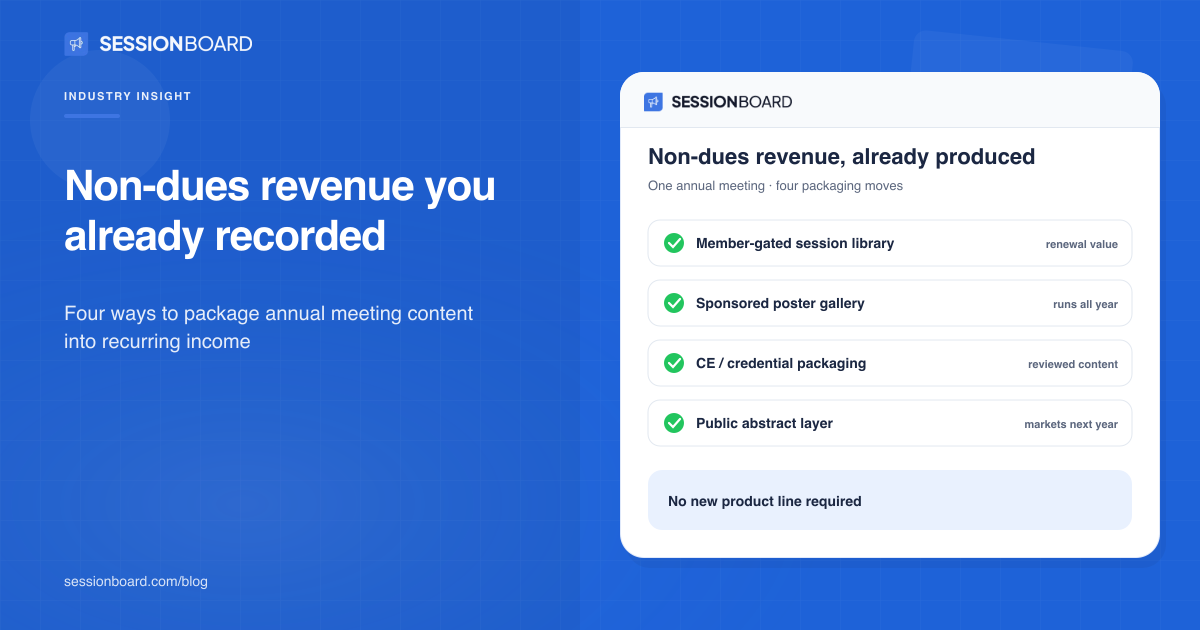
More than 60% of associations are diversifying revenue, per ASAE. The fastest new…
See how real teams simplify speaker management, scale content operations, and run smoother events with Sessionboard.
