
August 4, 2026

3
min read
Retention is decided in the eleven months between meetings
ASAE names retention the top association challenge. The renewal decision forms in the…


ASAE names retention the top association challenge. The renewal decision forms in the…
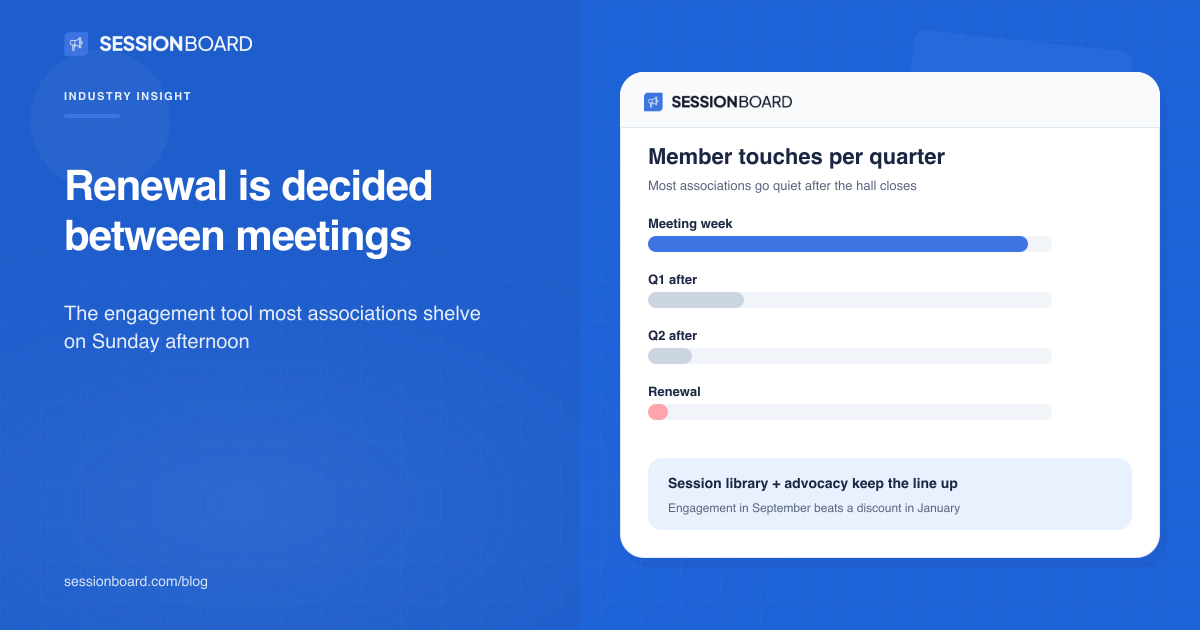
Nearly a third of association executives told ASAE that retention and engagement is their top challenge, the number-one finding in the sector's first State of Associations report. The same report shows dues increases doubling year over year. Put those side by side and you get the shape of the problem: associations are asking members to pay more at the exact moment members are least sure what they are paying for.
Ask a lapsed member when they decided not to renew and they will rarely name a moment. The decision accumulated. A conference they skipped, a newsletter streak they stopped opening, a year where the only mail from the association that required a decision was the invoice. Renewal is not lost at renewal time. It is lost quietly, in the months when the association had nothing to offer but a reminder that it exists.
Which is why it matters that most associations put their single best engagement asset in storage every year.
The annual meeting is, for most members, the most intense contact they ever have with the association: the field's research, its people, its arguments, in one room. Then the room closes. The sessions that members rated, took notes in, and told colleagues about become files in a drive. The poster hall, months of submissions and review, comes down in an afternoon.
The engagement did not have to stop. It stopped because the content's home was the event instead of the association.
A member who can search last year's sessions in March is touching the association in March. An author whose poster carries a durable link, and who still gets questions on it in the fall, is having the kind of professional experience dues are supposed to buy. A member who shares a session clip with a colleague is doing the association's recruiting. Each of those is a renewal argument delivered months before the invoice, and none of them requires producing anything new. The meeting already produced it.
Engagement between renewals has a second engine, and it is the members themselves. Speakers who present at the meeting have every reason to share their session afterward if someone hands them the link, the clip, and the moment. Attendees who found a poster useful will pass it along inside their institutions. Associations sit on networks that commercial event brands would pay dearly for, and most of them activate those networks for exactly the six weeks before registration closes.
Run it year-round instead. Confirmation pages, follow-up emails, and the content library itself can all carry share paths, so the field's work keeps circulating with member names attached. The association's content markets the association, carried by the people whose careers it serves. We build the advocacy tooling for this at Sessionboard, and the pattern holds regardless of tooling: members who share are members who stay.
There is a measurement gift hidden in all of this. Content engagement is legible in a way that "member sentiment" never is. Who searched the library this quarter. Which posters drew reading time and questions. Which members shared something, and which members have not touched the association since the hall closed.
That last list is the retention list. A membership director holding it in September can run a re-engagement campaign built on the member's own field, their tracks, their colleagues' new work, months before the renewal decision hardens. A director without it finds out in the renewal report, when the only remaining tool is a discount.
ASAE's report describes a sector responding to pressure with partnerships, new offerings, and price increases. All defensible. But the retention finding at the top of the report has a quieter answer sitting in every association's own archive: the meeting already earns the engagement once a year. The work is letting it keep earning for the other eleven months.
ASAE's 2026 State of Associations report found retention and engagement cited as the top challenge by nearly one-third of association respondents. Members increasingly compare dues against free information and a la carte alternatives, and an annual renewal notice is often the only touchpoint that asks them to weigh that value.
For many associations the meeting is the strongest engagement event of the year and the only one. Members who engage with meeting content, colleagues, and the field between meetings renew at higher rates than members whose only touch is the renewal invoice.
Searchable session and poster libraries members return to, author Q&A that continues after the hall closes, speaker and attendee advocacy that keeps members sharing the field's work, and engagement analytics that show which members are drifting before the renewal date arrives.
Content engagement is one of the earliest signals available. A member who searched the library, shared a session, or asked an author a question in the last quarter is present. A member with no touches since the meeting is a renewal risk you can act on months early.


Stay up to date with our latest news

.png)
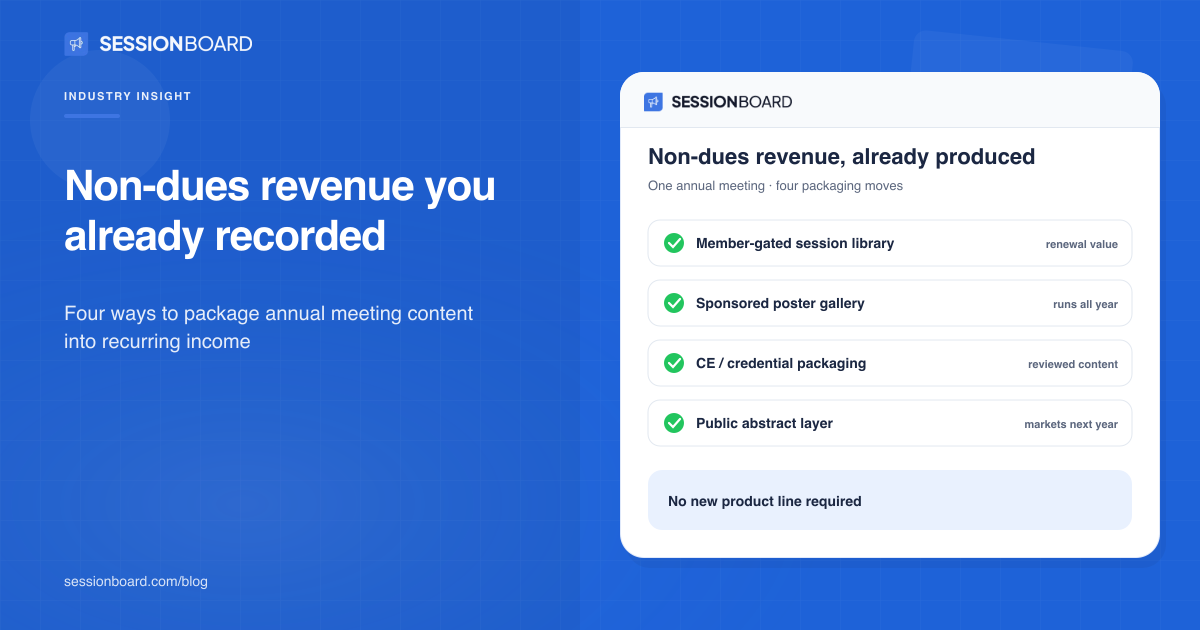
More than 60% of associations are diversifying revenue, per ASAE. The fastest new…
See how real teams simplify speaker management, scale content operations, and run smoother events with Sessionboard.
