
August 3, 2026

4
min read
Member-driven event promotion: the channel your association already owns
Faculty, chapters, and committees can outperform your ad budget. How associations run…


Faculty, chapters, and committees can outperform your ad budget. How associations run…

An education director at a mid-sized medical society told us her board asks the same question every fall: registration is flat, so what's the marketing plan? The honest answer was an email calendar and a modest ad spend that gets more expensive every year. Meanwhile the society has 14,000 members, 40 committee volunteers, 200 faculty on the annual meeting program, and 9 regional chapters. None of them appeared anywhere in the plan.
That's the situation for most associations. The most persuasive channel they own is membership itself, and it goes unused because nobody has time to run it by hand.
A physician deciding whether to attend your annual meeting doesn't weigh your display ad against her calendar. She notices when the colleague who chairs her section posts that he's presenting, or when her chapter president writes that the regional delegation is going again this year. The message arrives with a face she knows attached, inside a community she already belongs to.
Associations are unusually rich in these messengers, and each group carries a different kind of trust:
Faculty and session chairs. Their names are on the program. A presenter announcing her own session reaches an audience that follows her professionally, and the announcement reads as pride, because it is.
Committee and section leaders. Volunteers who shaped the program can speak to why this year's content matters. Their endorsement carries the weight of the review process behind it.
Chapter leaders. Regional trust. A chapter president rallying a delegation converts members the national office has never successfully emailed.
Last year's attendees. The only group that can vouch for the experience itself, which makes them the right voice during early-bird season when fence-sitters need social proof rather than another agenda highlight.
The reason member promotion stays aspirational is mechanical. Asking 200 faculty to "share on social" produces a handful of posts and no way to see what happened. Three things turn it into a program:
A personal share page per advocate. Each faculty member, chair, and chapter leader gets a page with their photo, their session or role, pre-written copy, and graphics with their name on them. Sharing takes under a minute, and the asset makes the advocate look good, which is the actual price of participation.
Assets timed by the program, on their own. Acceptance letters, agenda publish, early-bird, event week. Each milestone triggers a fresh asset to the right advocates automatically, so a faculty member gets her "I'm presenting" graphic the day her session is confirmed, while the enthusiasm is real. In Sessionboard, Advocacy fires these from program state, and the Advocacy Agent re-nudges advocates who haven't shared.
A tracked link on everything. Registrations accrue against the member who drove them. The education director can tell her board which chapters produced delegations, which committee members moved registrations, and what the faculty channel produced against the ad line. Flat registration stops being a mystery with a marketing plan attached and becomes a set of levers with names on them.
Your AMS holds the membership graph. The program side, where sessions, faculty, and abstracts live, is where advocacy has to run, because that's where the milestones fire and where a person's program role is known. Teams on iMIS, Fonteva, or Aptify keep the AMS as the member system of record and reconcile attributed registrations back to member records. The works-with guides cover the patterns.
One more surface worth claiming: the membership lifecycle emails the AMS already sends. Renewal confirmations and chapter newsletters can carry each member's own share link the same way registration confirmations do, which puts event promotion inside touchpoints with open rates your marketing emails will never see.
Nobody launches all four advocate groups at once. The sequence that works: faculty first, because acceptance season creates a natural trigger and the assets almost write themselves. Chapters second, before early-bird, with a leaderboard the chapter presidents can see. Attendees third, at registration confirmation. By the second cycle you have per-group conversion history and the board question answers itself with a chart.
Route promotion through the people members already trust: faculty, committee chairs, chapter leaders, and past attendees. Give each one a personal share page with a tracked link and assets timed to program milestones. Member trust converts where cold ads stall.
Start with the people whose names are on the program: faculty and session chairs. Then committee and chapter leaders, who carry regional trust, and last year's attendees, who can vouch for the experience. Each group needs different assets and a different reason to share.
The AMS stays the member system of record. The advocacy layer runs on the program side, where sessions, faculty, and registrations live, and each advocate's tracked link ties registrations back to a member record you can reconcile with the AMS.
Give every advocate a tracked link and count registrations against it. You'll see which chapters, committees, and faculty actually moved registrations, which tells you where to invest recognition and where a nudge is needed next cycle.
Peer-to-peer event marketing on Sessionboard · Speaker advocacy guide · Request a demo


Stay up to date with our latest news

.png)
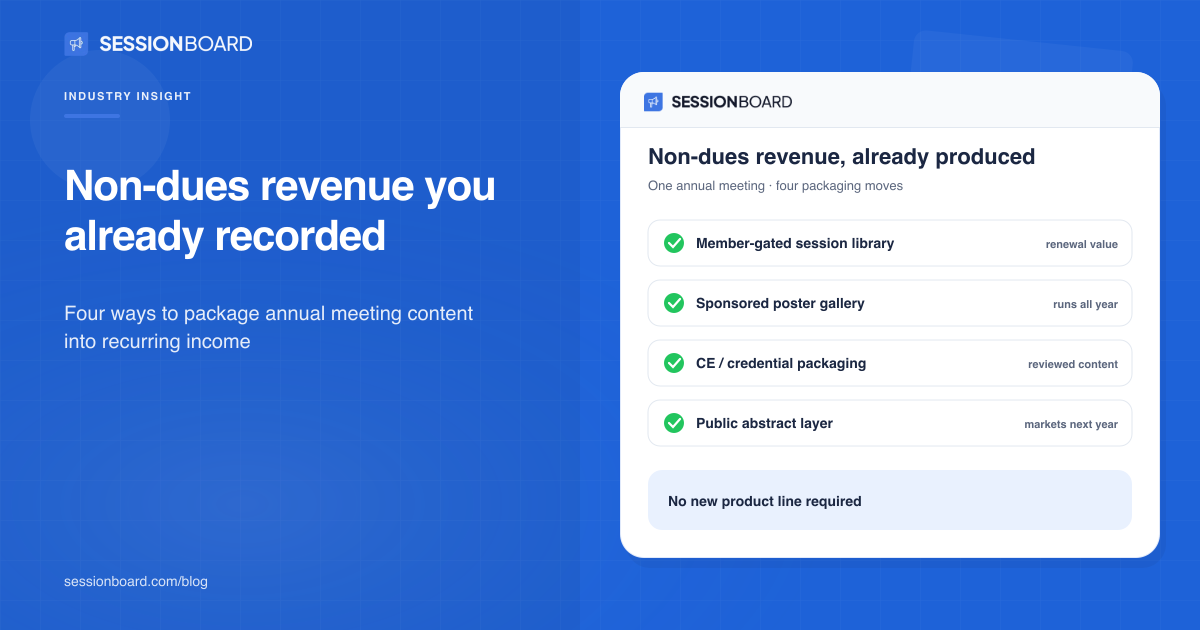
More than 60% of associations are diversifying revenue, per ASAE. The fastest new…
See how real teams simplify speaker management, scale content operations, and run smoother events with Sessionboard.
