
August 3, 2026

4
min read
The business case an events director can take to a CFO
Attendance and NPS don't survive a CFO review. Three numbers do: consolidated program…


Attendance and NPS don't survive a CFO review. Three numbers do: consolidated program…
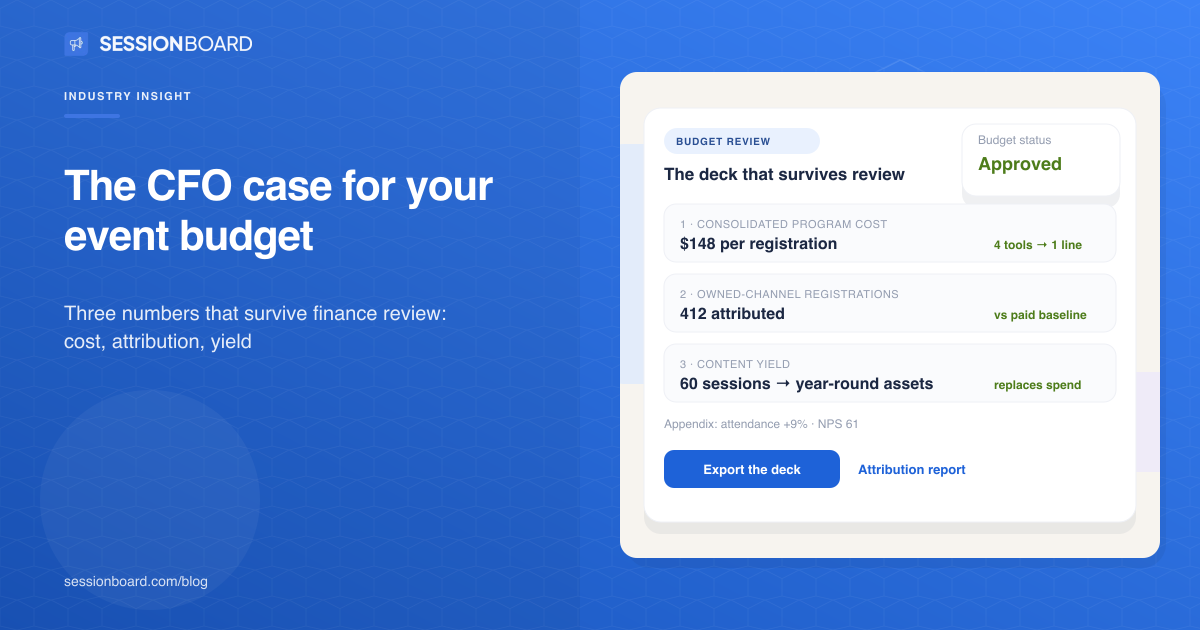
Budget season. An events director walks into the CFO's office with the deck that worked on the CMO: attendance up 9%, NPS at 61, a highlight reel from the general session. The CFO listens, then asks what the program costs per registration, which registrations the team's own channels produced, and what happens to pipeline if the event budget drops 20%.
The deck has no page for any of that. It rarely does. Vendelux surveyed B2B marketing and events leaders in 2026 and found 98% struggle to justify event spend to leadership, with 86% unable to tie event ROI to revenue. Events keep performing through all of this. The evidence just arrives shaped for the wrong reviewer.
A CFO doesn't distrust events. She distrusts unattributed spend, and in a year when nearly 70% of organizations are cutting event count (Forrester, Q1 2026), the programs that keep their budgets are the ones that show up with finance-shaped numbers.
Before defending the budget, know what the program actually costs. Most teams can't say, because the spend hides across line items: an abstract system, a speaker spreadsheet regime with staff hours attached, an agenda tool, an agency retainer for session graphics, a transcription vendor, ad spend. Pull it into one line and divide by registrations.
Two things happen. You get the denominator every later argument needs. And you usually find the first win, because overlapping tools and re-keying labor are the kind of waste a CFO cuts happily, and volunteering the cut buys credibility for the rest of the conversation. Consolidating submissions, speaker management, agenda, and content onto one program layer is often self-funding before any marketing benefit gets counted.
Here's where the argument usually turns. Paid registration cost is easy to compute and getting worse every year. What most programs can't show is the alternative working: registrations produced by speakers, members, and past attendees sharing with their own audiences.
Tracked advocate links make that a report instead of a theory. When every speaker, chapter leader, and attendee shares through their own attributed link, the deck gains the page it was missing: this many registrations came through owned channels, at this cost, against this paid baseline. A CFO can interrogate that number, which is exactly why it works. Attribution she can poke at beats a funnel model she can't.
The third number reframes the whole line item. A conference that produces 60 transcribed sessions has manufactured a year of marketing raw material: clips, quote cards, on-demand content, post-event advocacy assets that keep converting after the room empties. If content marketing was going to spend that budget anyway, the event just supplied it at marginal cost.
Put it in the deck as substitution: what the transcript pipeline produced, and what producing it elsewhere would have cost. The event stops being a cost center with a feedback survey and becomes upstream supply for the channels finance already funds.
Lead with the cost consolidation, because it's the number you volunteer rather than defend. Then attribution, then yield. Keep attendance and NPS in the appendix; they answer "was it good," and the meeting is about "what did it return."
One more move earns trust: name what you can't attribute yet. Deals influenced by hallway conversations, member retention effects, brand value. A CFO hears honest uncertainty as competence. The directors who lose this meeting are the ones who claim everything, because then every number gets discounted together.
Sales teams: this structure works in reverse. If your buyer is an events director fighting this review, the three numbers are what your proposal should promise to produce.
Bring numbers a finance leader can interrogate: consolidated program cost per registrant, registrations attributed to owned channels instead of paid, and the content yield each event produces for the rest of the marketing calendar. Attendance and satisfaction scores support the case. They are not the case.
Cost per attributed registration, pipeline or membership revenue traced to the event, spend consolidation across tools and agencies, and what the event feeds the rest of the year. A CFO reads NPS as a health check, not a return.
Start with what's traceable today: tracked advocate links tie registrations to owned channels, and content produced from sessions replaces spend you'd otherwise approve. Two honest numbers beat a modeled funnel a CFO won't trust.
Teams running separate systems for submissions, speakers, agenda, and content typically pay for overlapping licenses plus the staff hours spent re-keying between them. Consolidating onto one program layer turns several line items into one, which finance notices before any marketing metric.
Abstract and speaker management on Sessionboard · Peer-to-peer event marketing · Request a demo


Stay up to date with our latest news

.png)
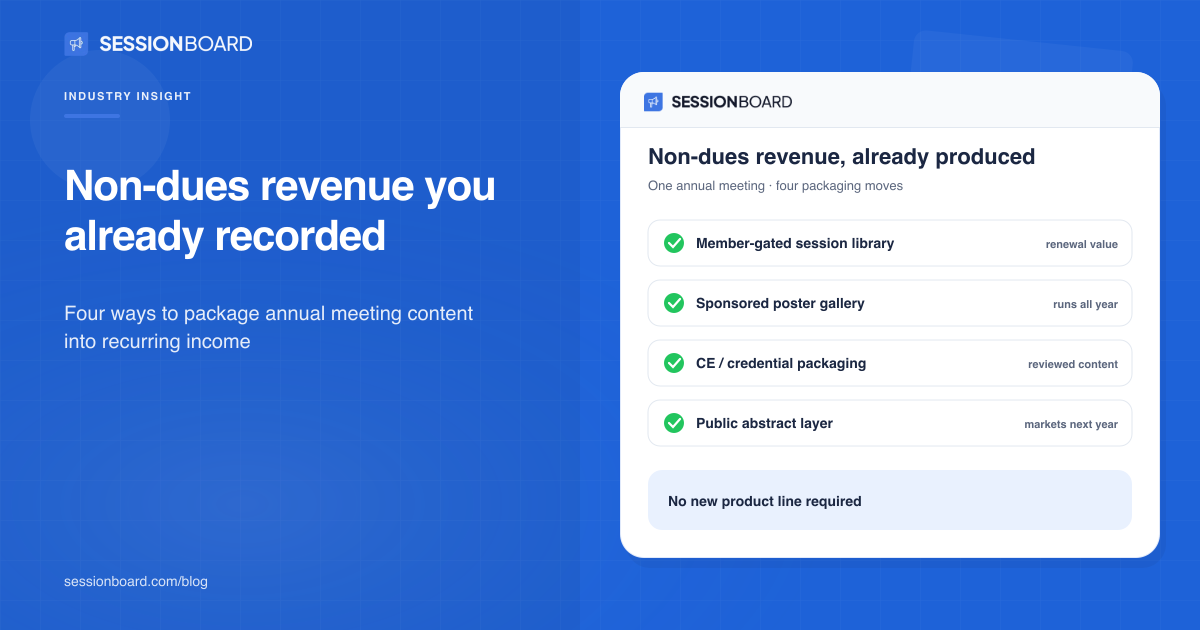
More than 60% of associations are diversifying revenue, per ASAE. The fastest new…
See how real teams simplify speaker management, scale content operations, and run smoother events with Sessionboard.
