
August 3, 2026

4
min read
Consent, embargo, and disclosures: the ePoster work nobody puts in the demo
Publication consent, embargo timing, disclosures, and withdrawals: where ePoster…


Publication consent, embargo timing, disclosures, and withdrawals: where ePoster…
It arrives a few weeks after the meeting, usually from a department chair or a journal editor, and it says some version of: why is this poster publicly available online? Maybe the study is under review at a journal with a prior-publication policy. Maybe the author's industry partner never cleared public release. Maybe the poster was withdrawn in March and the gallery didn't get the memo.
Whoever answers that email discovers quickly that "the vendor handled the posters" is not an answer. The society published the work. The society owns the question.
ePoster platforms sell the visible half of the product: the gallery, the screens, the viewer counts. The half that determines whether the program is safe to run is quieter, and it almost never appears in a sales demo, because it isn't glamorous. It's four administrative problems, and every large scientific meeting has all four.
Standing beside a poster for ninety minutes in a convention hall and having that poster permanently searchable on the open web are different acts with different consequences. An author may happily do the first and be forbidden the second, by a journal's prior-publication rules, an institution's IP office, or a sponsor agreement she signed without reading closely.
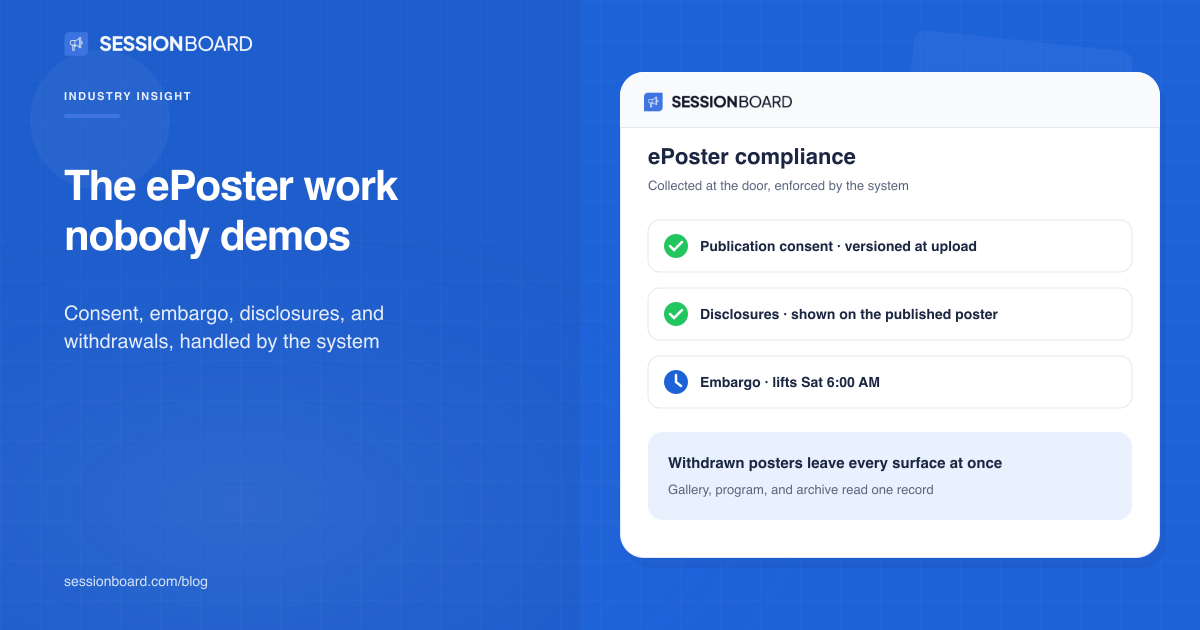
So publication consent has to be its own explicit question, asked of every author, recorded with a timestamp and the text they agreed to. "We emailed everyone and assumed yes" fails the moment anyone pushes on it, and consent gathered once, informally, can't handle the author who agrees in April and changes her mind in June when the journal accepts her manuscript.
The workable pattern puts the question at the upload itself. The author submits her poster through the same speaker portal where her bio lives, and granting or declining gallery publication is part of the submission, versioned like a contract. Decline means the poster presents onsite and never touches the public gallery. Nobody reconciles a spreadsheet against an inbox in meeting week.
Late-breaking abstracts exist because the best science often isn't ready by the regular deadline. They come with a complication: results embargoed until a specific date and hour, sometimes coordinated with a journal publication or a sponsor announcement. One poster appearing early in a public gallery can breach an agreement the society signed.
Policy memos don't hold back posters at 6am on a Saturday. The gallery has to do it mechanically: an embargoed poster stays dark until its release time and then appears on its own, with nobody on the program team awake, let alone clicking. A teaser mode helps here, showing title and authors while the content stays hidden, so the program looks complete while the science waits for its clock. In Sessionboard's gallery, embargo is a field on the poster record, and the teaser state is what attendees see until it lifts.
Medical societies already collect financial disclosures during submission; CME accreditation more or less requires it. The failure happens downstream, at display time, when disclosure lives on whatever slide the author remembered to include. Some do. Some paste last year's. Some forget, and now the gallery shows an industry-funded study with no disclosure visible, which is the kind of detail accreditation reviewers and rival researchers both notice.
The fix is unglamorous: the disclosure data collected at submission renders on the published poster page automatically, in a consistent place, from the record. Authors stop being the enforcement mechanism for the society's compliance policy, which is good, because they were never going to be reliable at it.
A withdrawn poster is the sharpest version of the problem. Work gets pulled after acceptance for real reasons: errors found, misconduct alleged, authorship disputed. From that moment, every place the poster still appears is a live risk, and a large program has more of those places than anyone remembers: the gallery, the program listing, the mobile app, the archive, the judging sheets.
If withdrawal is an email, someone has to remember every surface. If withdrawal is a status on the abstract record, and the gallery, program, and archive all read from that record, the poster disappears from all of them at once. This is the strongest argument for running posters on the same program graph as the rest of the meeting rather than on an exported copy: an export can't hear about the withdrawal.
None of these four problems is difficult on its own. What makes them dangerous is scale and timing: nine hundred authors, four deadline waves, and every failure surfacing in public, after the meeting, with a member's name attached.
A program team can run all of it on vigilance, and many do, at the cost of a meeting week spent policing spreadsheets. Or the workflow can carry the compliance: consent and disclosures collected at the door, embargo enforced by the clock, withdrawal propagating as a status change. The second version is quieter. The Tuesday email still comes occasionally, but the answer is a record you can quote, not an investigation you have to launch.
Yes. Presenting in a hall and being published to a persistent online gallery are different acts, and authors (and sometimes their institutions or journal agreements) may permit one and not the other. Collect explicit, versioned publication consent at upload, before anything goes live.
Late-breaking science, industry-sponsored studies, and work under journal consideration often cannot appear publicly before a set date and time. The gallery has to hold those posters back automatically, ideally showing a title-and-authors teaser until the embargo lifts, so the rest of the hall can open on schedule.
Funding sources and conflicts of interest, following the society's disclosure policy (and ACCME expectations where CME is involved). Disclosures collected during submission should display on the published poster automatically rather than depending on each author remembering to include them.
The poster has to come out of the gallery, the program, and the archive at once. Withdrawal handled as a record status propagates everywhere automatically; withdrawal handled by email produces the version everyone fears, where a retracted study is still sitting in the public gallery months later.


Stay up to date with our latest news

.png)
More than 60% of associations are diversifying revenue, per ASAE. The fastest new…
See how real teams simplify speaker management, scale content operations, and run smoother events with Sessionboard.
