
July 28, 2026

3
min read
The content layer registration vendors don't want to talk about
Registration won the RFP. Abstracts, speakers, and schedule truth still need an owner.


Registration won the RFP. Abstracts, speakers, and schedule truth still need an owner.
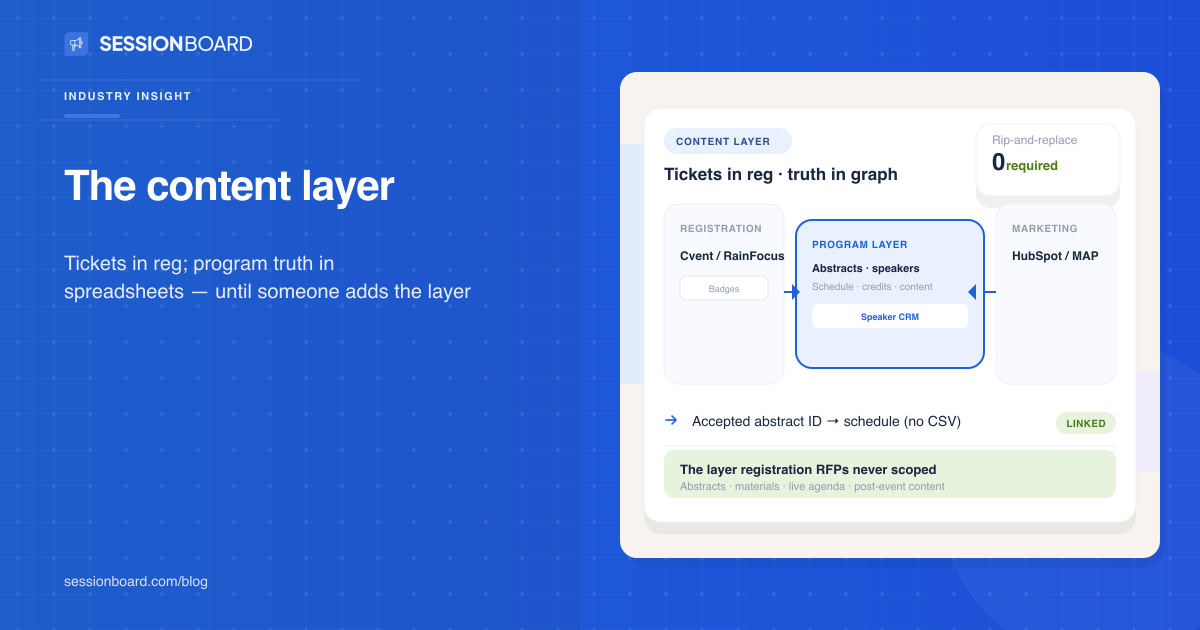
The RFP is signed. Registration, housing, and badges are covered. Then someone asks the question that always lands in the program director's lap: who owns abstracts, session materials, and the schedule that becomes the real program?
Too often the honest answer is "we'll figure it out in Excel."
Registration vendors excel at the attendee record. They were never scoped to run CFP committees, credit attestation, or the speaker portal your faculty expects.
Examples: RainFocus or Cvent owns badges while abstracts and speaker materials live elsewhere; HubSpot runs nurture while schedule truth sits in spreadsheets; a trade show registration portal that never sees education-theater speaker swaps.
The content layer is the program record — abstracts, speakers, materials, schedule truth, credits, awards, and post-event content — beside registration, not inside it. You do not rip and replace; you add depth where complexity lives.
A program layer beside registration:
Association: Registration handles member pricing tiers; the program layer runs 1,800 abstract submissions, 12 review committees, and gala awards on one speaker CRM.
Corporate: Cvent (or similar) owns SKO badges; Sessionboard owns SME materials collection, breakout scheduling, and the content marketing lifecycle after sessions end.
Med/sci / trade show: Registration counts badges; the layer manages credit format tags, faculty swaps, and education theater schedules that accreditation and exhibitors both reference.
Read the pattern: Speaker content when registration won the RFP
Compare coexistence: When you need a program layer, not another EMS
Open stack: Event content marketing without replacing your registration stack
The program record for abstracts, speakers, materials, schedule, and post-event content — beside registration.
Buyers optimize for tickets; program work is assumed to be spreadsheets after sign.
No — add a program layer that integrates without migrating attendee records.
Share on LinkedIn? One line: registration won the RFP; abstracts and schedule truth still need an owner. The content layer is the program record beside tickets — not a second registration database.


Stay up to date with our latest news

A step by step guide to running a poster session.
The KPIs that show whether your event program worked.
See how real teams simplify speaker management, scale content operations, and run smoother events with Sessionboard.
