
August 3, 2026

4
min read
What keeps event advocates sharing (it isn't gift cards)
Gift cards buy one share. Status, effortless assets, and visible attributed impact…


Gift cards buy one share. Status, effortless assets, and visible attributed impact…
A conference team we work with ran a referral push two seasons ago: share your registration link, earn a coffee card when someone signs up. Participation looked fine in week one. By week four the dashboard told the real story. Most advocates shared exactly once, collected nothing, and never came back. The few who earned a card didn't share again either. The team had bought a batch of single transactions and called it a program.
Their program manager said the part that stuck with us: the people who kept sharing all season were the ones who never asked about the reward.
Look at who actually sustains promotion for an event and the pattern is consistent. They're presenting, chairing, organizing a chapter delegation, or proud alumni of last year's edition. Sharing serves something they already care about, which means the useful design question is what the share does for the person sharing. Three motivators do most of the work, and none of them costs a reward budget.
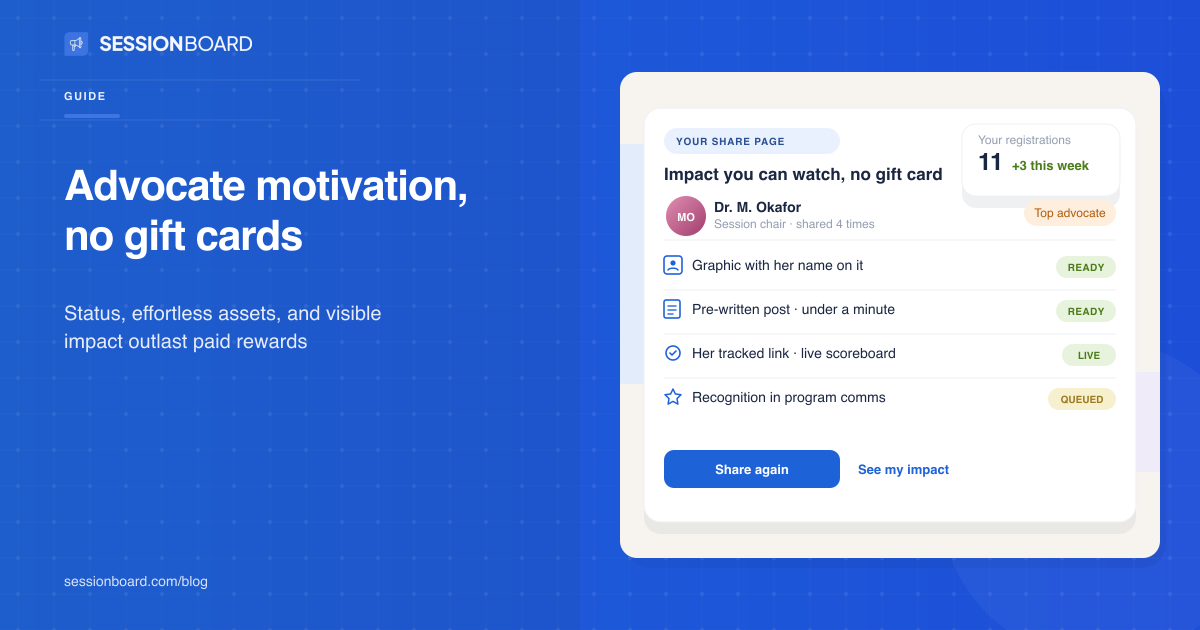
The asset flatters the advocate. A speaker doesn't share your event banner; she shares the graphic with her name, her session title, and her headshot on it, because posting it is a professional announcement about her. Same for a committee chair credited on the program he shaped. Make every asset about the advocate first and the event second, and sharing becomes self-interest you don't need to compensate.
Sharing takes less than a minute. Motivation is fragile. The advocate who has to write a post from scratch, hunt for an image, and find the right link doesn't share, however much goodwill exists. A personal share page with pre-written copy and the tracked link already attached removes every excuse between intent and post.
The advocate can see their own number. This is the one most programs miss. An advocate who watches registrations accrue against their link acquires something a gift card never creates: a running score they want to move. The speaker who drove eleven signups checks whether it hit fifteen after her next post. Impact feedback turns one share into a season of them, because the number belongs to the advocate.
Beyond fading fast, payments carry costs that surface later. For medical and scientific associations, paying physicians triggers transparency reporting in several jurisdictions, so legal review enters your marketing loop. Rewards also skew who participates: you recruit deal-hunters rather than the high-trust voices whose endorsement was the point. And once a reward exists, removing it converts a warm advocate into someone you took a payment from.
Recognition avoids all of it. Naming the top chapter in the president's newsletter, giving faculty advocates priority housing or session placement consideration, or simply showing an advocate that their shares produced a measurable slice of registration: these age well, and no one has to fill out a disclosure form.
None of this runs by hand at 200 advocates. In Sessionboard, Advocacy generates each advocate's share page from program state, so the flattering asset exists the day a speaker is confirmed. Milestones fire fresh assets automatically at agenda publish, early-bird, and event week, giving advocates a new reason to post while the Advocacy Agent nudges the ones who went quiet. And every advocate sees their own clicks and registrations, which is the feedback loop doing the motivating.
The same design covers attendees, whose motivator is belonging rather than reputation: "I'm going" is a statement about professional identity, and the confirmation-page share link catches it at the moment it's true.
Usually no, and for med/sci associations payments can create compliance problems. Advocates keep sharing when the asset makes them look good, when sharing takes under a minute, and when they can see the registrations their own link produced. Status and visible impact outlast gift cards.
A reward pays for the first share, then the effect fades: the advocate did the transaction and moved on. Impact feedback works differently. An advocate who watches signups accrue against their link has a reason to share again at the next milestone, because the number is theirs.
Reputation. A speaker shares assets that present them well: a personalized graphic with their name and session, a polished clip of their talk, a quote card. Make the asset flattering and effortless, and promotion becomes something speakers do for themselves.
They can be. Payments to physicians trigger transparency reporting in several jurisdictions, and honoraria rules vary by society. Recognition, visible impact numbers, and program perks like priority housing avoid the compliance question entirely.
Speaker advocacy guide · Peer-to-peer event marketing on Sessionboard · Request a demo


Stay up to date with our latest news

.png)
More than 60% of associations are diversifying revenue, per ASAE. The fastest new…
See how real teams simplify speaker management, scale content operations, and run smoother events with Sessionboard.
