Templates

Post-event survey questions

Attendee, session, and speaker survey questions — with scales and timing that protect response rates.
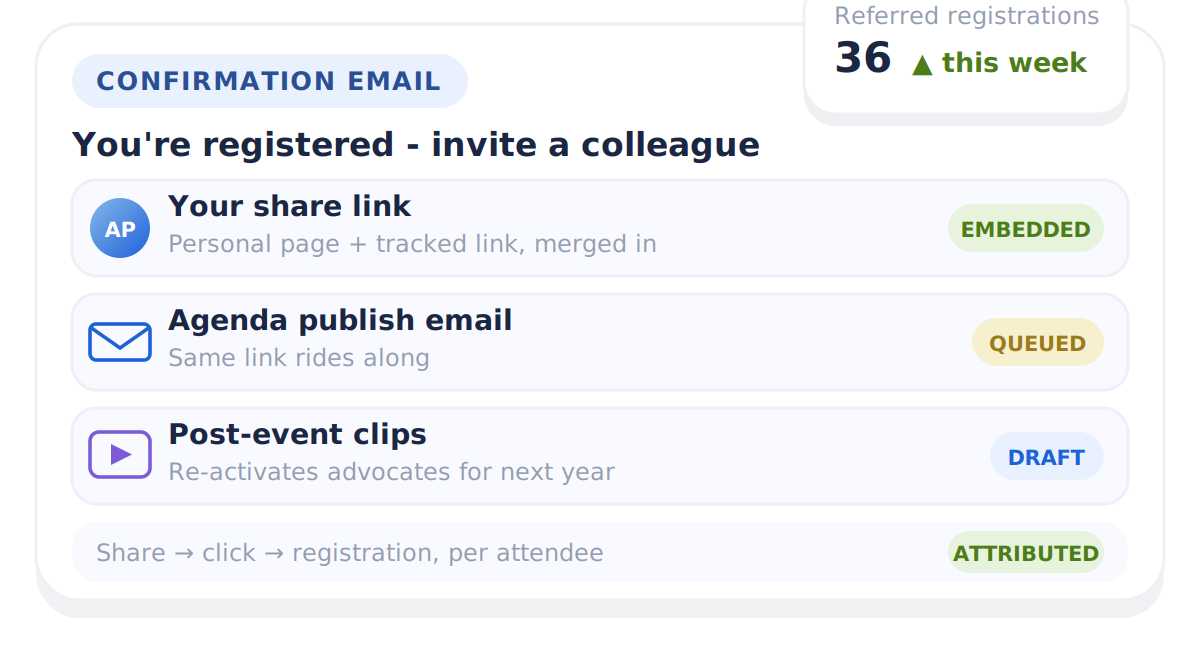

Attendee advocacy from the registration confirmation - embedded share link, lifecycle emails, and referral attribution
Trusted by teams running Informa, FT Live, medical societies, and global enterprises
Informa
Clarion Events
Financial Times
Dynatrace
ACEP
AVIXA
NACD
ASHG
American Society of Anesthesiologists
Google
Docebo
NRECA
CyberRisk Alliance
AdventHealth
Questex
IAAPA Expo
NAEYC
Informa
Clarion Events
Financial Times
Dynatrace
ACEP
AVIXA
NACD
ASHG
American Society of Anesthesiologists
Google
Docebo
NRECA
CyberRisk Alliance
AdventHealth
Questex
IAAPA Expo
NAEYC

Quick answer

Good post-event surveys are short, specific, and sent within 24 hours. Ask overall value as NPS or 5-point scale, what drove attendance, which sessions delivered, and one open question you will actually read. Session-level feedback belongs in its own two-question pulse tied to each session, not a 40-item year-end form. Speaker surveys close the loop for next year's program.

Event-level survey — 8 questions max

Send within 24 hours while the lanyard is still on the desk. One scale question set, two open answers.

  1. How likely are you to recommend this event to a colleague? (0–10 — your NPS baseline year over year)
  2. Overall, how valuable was the event for you? (1–5, anchored: 1 = not worth the time, 5 = clearly worth it)
  3. What was the main reason you attended? (choice: program topics / specific speakers / networking / CE credits / exhibits)
  4. Did the program deliver on that reason? (1–5)
  5. Which single session or moment was the most valuable? (open — this line writes next year's marketing)
  6. What should we change or drop next year? (open — read every answer)
  7. How was the venue and logistics experience — registration, rooms, food? (1–5, one combined question, not five)
  8. May we contact you about next year's program committee, speaking, or early registration? (opt-in checkboxes)

Session-level pulse — 2 questions per session

Attach to each session in the app or follow-up, not a year-end omnibus. Response rates triple when the ask is tiny and immediate.

  • Rate this session (1–5 stars — one tap, no login wall)
  • One thing you'll use from this session? (open, optional — doubles as testimonial pipeline and speaker feedback)
  • For CE/CME sessions add the required knowledge-check and disclosure confirmation to the same flow, not a separate portal
  • Route results per session to the program committee — aggregate scores decide repeat topics; open answers decide repeat speakers

Speaker & faculty survey — retention questions

Faculty who feel taken care of come back and recruit peers. Five questions, sent within a week.

  1. How was your experience as a speaker, from acceptance to stage? (1–5)
  2. Did you have what you needed before your session — AV, room setup, timing, audience info? (1–5 + open)
  3. How was the submission and review process? (1–5 — this measures your CFP tooling, read it honestly)
  4. Would you speak again, and what topics are you developing for next year? (open — this seeds next year's program)
  5. Anyone in your network we should invite to submit? (open — cheapest speaker sourcing that exists)

Mistakes that kill response rates

  • Sending a week later — every day after the event halves your response rate; send within 24 hours
  • Thirty questions because every stakeholder added three — cap event-level at 8, cut anything nobody will act on
  • Unanchored scales — label what 1 and 5 mean or the averages mean nothing
  • Asking session feedback in the year-end survey — nobody remembers Tuesday's 2pm panel; pulse per session instead
  • No follow-through signal — tell attendees one change last year's feedback caused; response rates compound when people see effects
  • Survey data in a silo — scores that never reach the program committee or speaker records change nothing next cycle

Frequently asked questions

An NPS or recommendation question, overall value on an anchored 1–5 scale, why they attended and whether the program delivered on it, the most valuable session, one open change question, one combined logistics rating, and a contact opt-in. Eight questions maximum at event level.

Within 24 hours of the event closing — sooner for session-level pulses, which work best in the event app while the session is fresh. Every day of delay costs response rate.

Event-level surveys typically see 10–30% depending on audience relationship and brevity; in-app session pulses can run far higher because the ask is two taps. A short survey answered by a third of attendees beats a long one answered by 4%.

Yes. Session feedback should be a two-question pulse attached to each session, sent or prompted immediately. A year-end omnibus asking about individual sessions gets guesses, not feedback.

Share aggregate scores and constructive open answers with each speaker — it's the cheapest faculty-retention tool you have, and it makes the ask to return next year concrete instead of flattering.

Scores should attach to session and speaker records, not live in a spreadsheet. On Sessionboard, feedback lands on the same program record as the session and its faculty, so the next cycle's committee starts with last year's evidence.

Close the loop on the same record the program ran on

Talk through your event workflow — abstracts, speakers, content, and marketing on one program graph.

Loading form…