★★★★★
“Sessionboard has been one of our most successful investments this year, making our team more efficient and allowing us to focus on the most critical components of our events.”

Live capture, speaker labels, and one transcript that becomes summaries, clips, and replays on the program you already run.
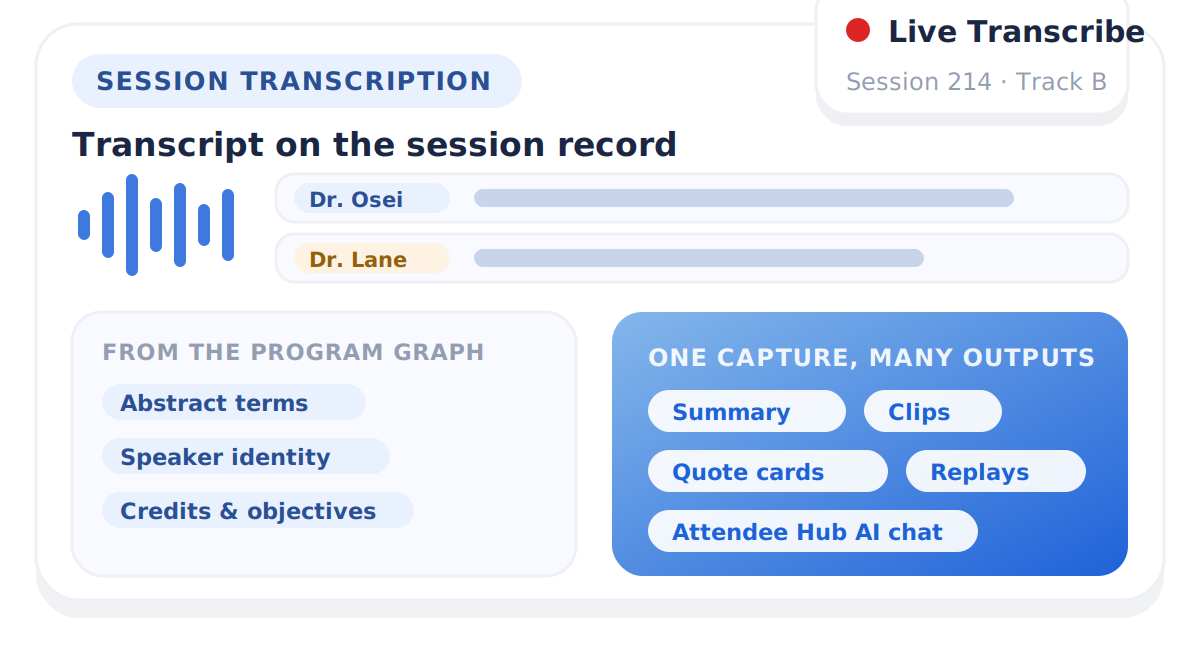




Conference transcription works best when capture starts from the program, not raw audio. Sessionboard runs Live Transcribe and batch transcription with diarization, grounded in each session's abstract and speaker names, and turns one capture into summaries, clips, quote cards, replays, and Attendee Hub AI chat. AI notetakers fit internal meetings; captioning vendors fit accessibility mandates.
Match your team to what session capture should produce, from compliance captions to a year-round content library.
Sessions end and the content is gone. One capture should produce summaries, clips, quote cards, and replay pages without a second vendor.
Generic AI butchers drug names and trial acronyms. Capture needs the session's own terminology, plus a path to credits and learning objects.
Recordings arrive as files named by room and date. Transcripts should land on the session record with speakers attached, not in a folder.
Captions are mandated; budget is finite. Live captioning should feed the same transcript the content team reuses afterward.
“Sessionboard has been one of our most successful investments this year, making our team more efficient and allowing us to focus on the most critical components of our events.”

“Sessionboard saves significant planning time and makes it easier than ever for speakers and sponsors to participate in our clients' events.”

“We used Sessionboard daily. It served as our source of truth for tracking speakers, sending emails, and accessing reports. The ability to set a weekly digest email was a huge time saver.”

“Honestly, I loved it! Getting everything out of the spreadsheet. It collects all the information and gives you a visual of who you might want to invite.”
No single tool covers every mandate. Match the approach to what the transcript is for, and to where your program and speaker data already live.
| Vendor | Best when | Tradeoffs | Pricing note |
|---|---|---|---|
| Generic AI notetakers (Otter, Fireflies) | Internal meetings and one-off webinars where a bot joins a call and nobody needs program context. | Built for meetings, not multi-track events. No session records, no speaker identity beyond voice guesses, terminology errors on technical programs, and output lands in another inbox. | Per-seat SaaS; cheap to start. |
| Captioning & translation specialists (Wordly, Interprefy) | Live multilingual captions and interpretation are the mandate, especially international congresses with many floor languages. | Deliverable is the live feed. Post-event reuse, session records, and content workflows sit outside; transcripts still need a home. | Per-event or per-hour AI interpretation pricing. |
| Content-intelligence portals (Snapsight, Rozie Synopsis) | A show floor wants real-time takeaway feeds across parallel tracks and the program runs nowhere in particular. | Capture starts from an audio line and ends in the vendor's portal, on a subscription that resets. No call for papers, no speaker CRM, and your transcripts live on their domain. | Per-event or annual content subscription. |
| Human transcription services (Rev, Verbit) | Verbatim legal-grade accuracy on a small number of high-stakes recordings, with time to wait. | Per-minute cost scales badly across a 300-session program, turnaround is days, and the output is a document, not a content pipeline. | Per-minute human rates. |
| Sessionboard | The program already lives here, so capture starts with context: Live Transcribe onsite, batch transcription with diarization in Media Library, terminology grounded in the session's abstract and speaker records, then summaries, clips, quote cards, replays, and Attendee Hub AI chat from one capture. Advocacy distributes the outputs through the speakers who drew the audience. | Strongest when call for papers, speakers, or the agenda run on Sessionboard. Pair with a captioning specialist when simultaneous interpretation across many languages is contracted. | Included with the program platform; no per-seat transcription SaaS. |
Converting the spoken content of conference sessions into text: live during the session for captions and real-time notes, or from recordings afterward. Done well, each transcript attaches to its session with speakers identified, so the text is findable and reusable rather than a loose document.
An audio feed from the room's AV system streams to a speech engine, and text appears within seconds for captions or live notes. Sessionboard's Live Transcribe captures per session on the agenda, so the live text lands on the right session record with the right speakers from the start.
Speech engines guess unfamiliar terms from sound alone, which is where drug names, trial acronyms, and subspecialty vocabulary go wrong. Capture grounded in the program does better because the session's abstract text and speaker names supply the terminology before anyone speaks.
They should keep working: AI summaries and session reports for attendees, clips and quote cards for marketing, replays with searchable text in Attendee Hub, and a multi-year Media Library the next program team can search. A transcript that ends life as a Word file was mostly wasted.
Captioning is the live, on-screen use of transcription for accessibility, and it carries formatting and latency requirements of its own. The same capture should serve both jobs: live captions during the session, and a structured transcript afterward for content reuse.
For English-language capture, summaries, and content reuse, yes. When a congress contracts simultaneous interpretation across many floor languages, run the specialist feed alongside and write the audio back to the session record through the public API.
Human services charge per minute, which compounds fast across a multi-track program. AI notetakers charge per seat. Portal products charge per event. Sessionboard includes transcription with the program platform, so a 300-session meeting doesn't carry a separate capture invoice.
Talk through your event workflow — abstracts, speakers, content, and marketing on one program graph.
Editorial guides from the Sessionboard blog.
 Learn
Learn
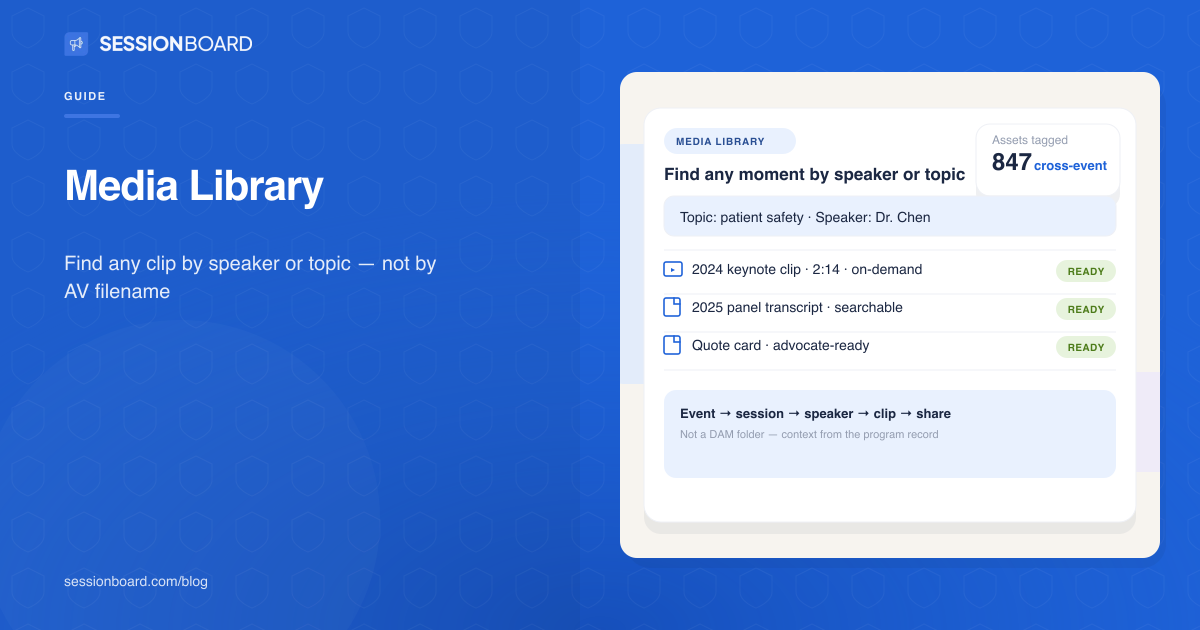
Tag a speaker once — find every session, clip, and asset across events.
Read article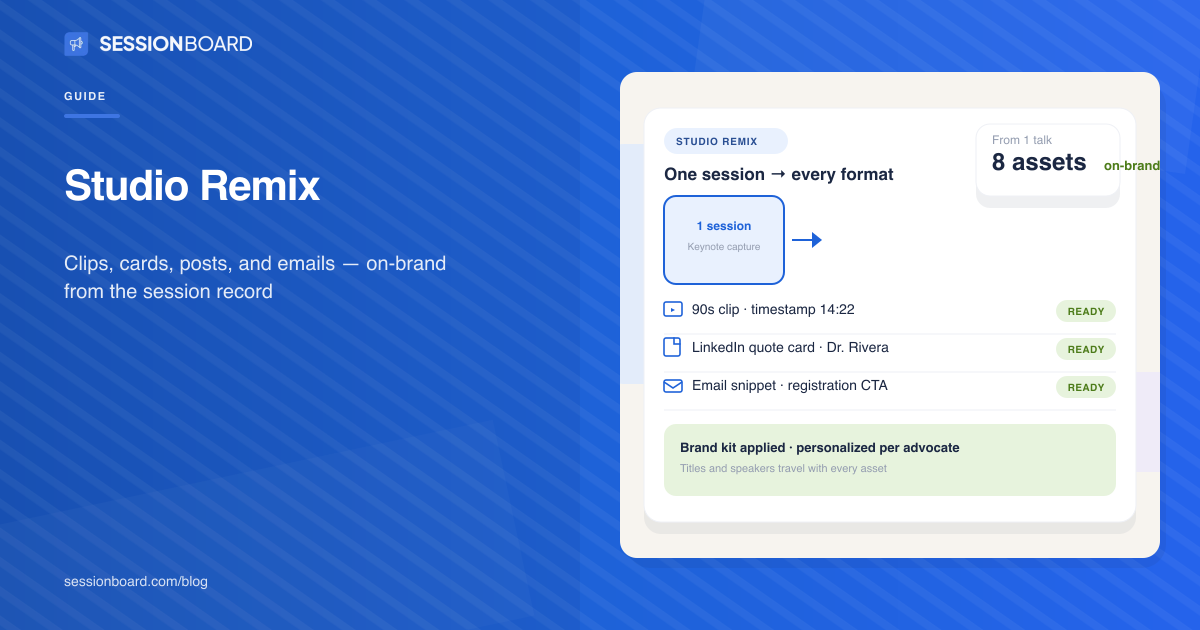 Learn
Learn
One session, many formats — clips, cards, posts, emails — on-brand from the graph.
Read article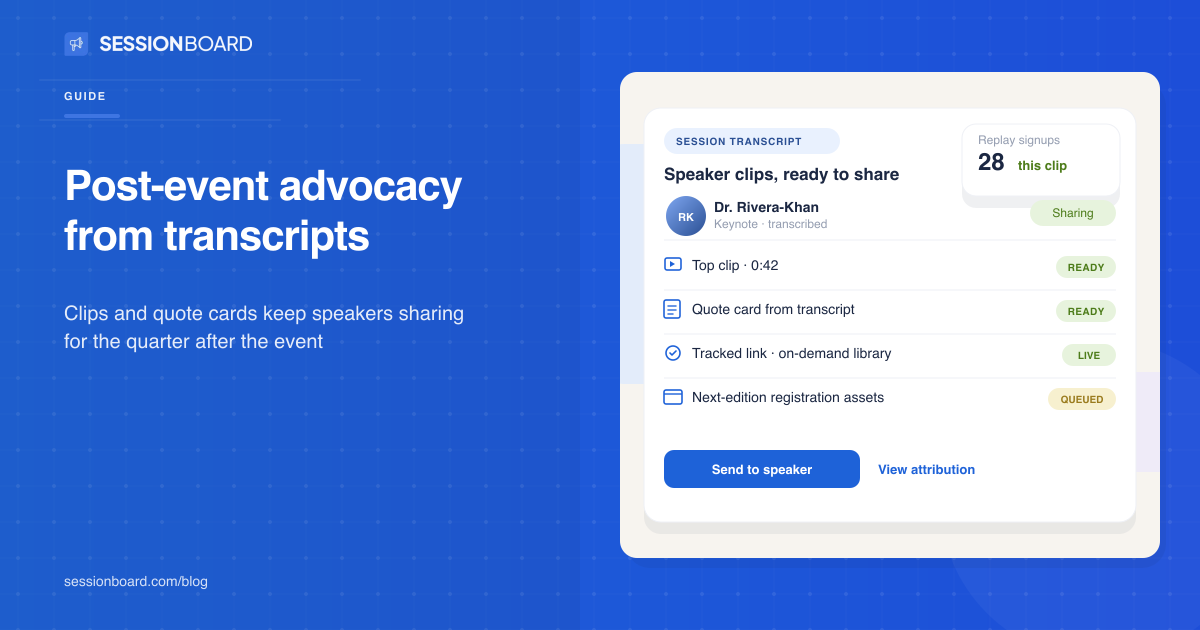 Learn
Learn
Session transcripts turn one event into a quarter of speaker advocacy: clips, quote cards, and tracked links that keep converting after the room empties.
Read articleWant transcripts that know your program?
Request a demo