
July 29, 2026

9
min read
Your speakers aren't ignoring promotion — they're ignoring assets built for the event, not for them
Speakers skip promo when assets sell the show, not their talk. Build speaker-first…


Speakers skip promo when assets sell the show, not their talk. Build speaker-first…
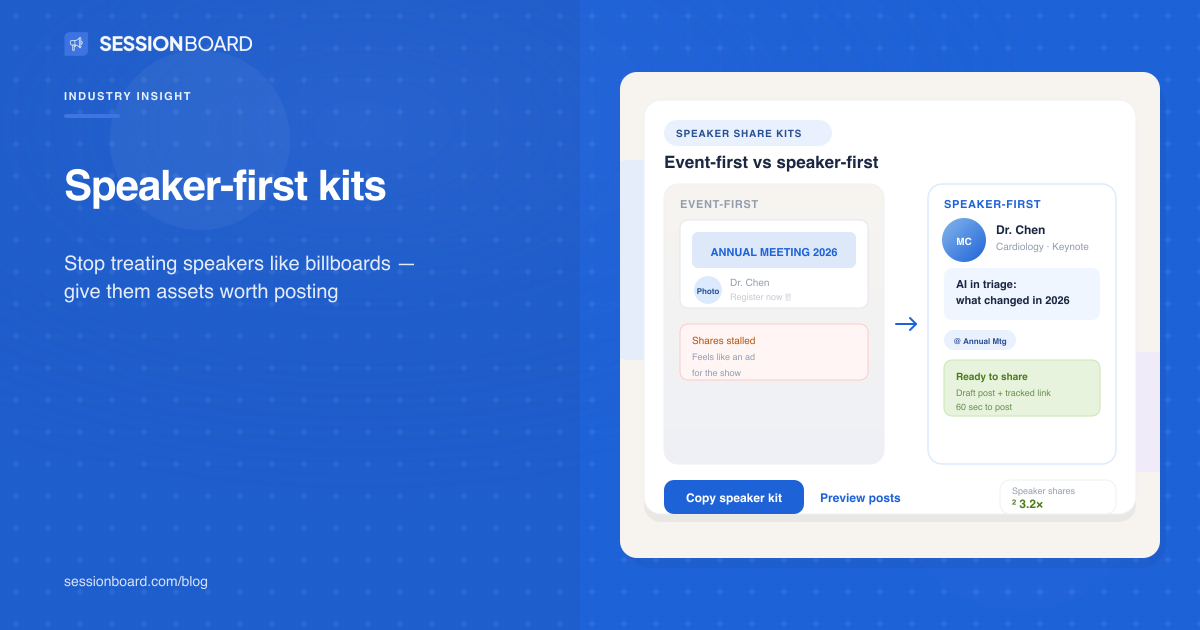
You sent the speaker kit. You posted in the portal. You nudged in Slack. Registration still flatlines on speaker-attributed traffic, and marketing starts asking why "willing" speakers won't lift a finger.
The usual diagnosis is apathy , they're too busy, they don't get social, they signed the contract and disappeared. That story is comforting because it puts the problem on them.
Talk to speakers who actually want their sessions to land, and a different pattern shows up. They are not refusing to promote. They are refusing to post something that makes their feed look like your billboard. One glance at a graphic dominated by venue photography, event hashtags, and sponsor lockups tells them: this post is for you, not for me.
That mismatch is expensive. Speakers, sponsors, and returning attendees remain your highest-trust acquisition channel , but only when the asset respects why someone would stake their name on a share.
For the full advocate playbook across speakers, exhibitors, sponsors, and attendees, see Speaker advocacy for events. This post goes deeper on why speaker-specific assets fail and how to redesign them by customer type.
Four failure modes show up in almost every post-mortem where "we gave them everything."
Typical speaker packs include:
From the speaker's perspective, that is not "content I am proud to share." It is collateral they would only post if marketing compliance required it , and most speaker agreements don't.
The psychological gap is simple: their audience follows them for ideas, not for your venue. When the visual hierarchy screams annual meeting, the share feels like free ad inventory on their personal brand.
A medical keynote might also be teaching, seeing patients, and preparing three other talks this quarter. An association volunteer speaker runs a day job. A corporate executive has a comms team that vetoes off-brand graphics.
Your show is rarely the center of their universe. Promotion competes with slide decks, travel, and the next deadline , not with Netflix. Anything that requires rewriting copy, cropping a logo, or guessing what tone to use slides to the bottom of the list.
That is not selfishness. It is rational prioritization when the kit does not save time and does not elevate their expertise.
Many teams ship the "social media toolkit" when registration opens , weeks or months after acceptance, when the speaker's excitement has cooled and their session outline is due.
Peak share intent often sits earlier:
A single blast at registration time misses the easiest shares and trains speakers to ignore future nudges.
When shares don't appear, teams send reminder emails. Speakers feel nagged. Marketing feels ignored. Neither side sees the real issue: the asset was never built for the speaker's job-to-be-done , look credible, tease the idea, drive the right people to the room.
Without share → click → registration attribution on the speaker record, the argument stays emotional. Budget drifts back to paid social, and the highest-trust channel stays under-funded for another year.
Speaker-first promotion inverts the hierarchy:
| Event-first (typical) | Speaker-first (what gets shared) |
|---|---|
| Logo and dates dominate | Session title and speaker name dominate |
| Copy: "Register for Annual Meeting 2026" | Copy: "I'll unpack X , here's why it matters" |
| One generic graphic | Variants: LinkedIn, Instagram story, email sig |
| Single send at registration | Milestone journey: accept → agenda → week-of |
| Speaker as distribution channel | Speaker as content partner |
Good kits still mention the event , as context, not the headline. Registration links are tracked so both sides see impact.
The bar is not "more creative design." It is less friction and more personal payoff in under sixty seconds.
The same principle applies everywhere; the emphasis shifts by ICP.
Audience: Chapter leaders, committee volunteers, member experts who speak for visibility with their association, not for a fee.
What they need: Copy that ties the session to member value , CE credit, policy update, chapter relevance , without sounding like headquarters marketing. Give chapter-specific tracked links when possible so a Florida member isn't pushing a generic national URL.
Avoid: National-brand graphics that make a volunteer look like they're shilling registration numbers to headquarters.
Example hook: "Sharing what we learned on [topic] at [Event] , if your chapter is wrestling with this, my session on [date] breaks down the playbook."
Audience: Clinicians and researchers whose reputations depend on substance, not event hype.
What they need: Session title, learning objective, and society context in clinical language. Visuals that look like a journal sidebar, not a festival poster. Pre-written posts that reference evidence or guideline gaps , not "join us in Nashville!"
Avoid: Stock photo montages, oversized sponsor strips on speaker graphics, copy that reads like consumer event marketing.
Example hook: "New data on [condition] changes how we think about [intervention]. I'll walk through the implications in my [track] session at [Society Meeting] , [link]."
Audience: Executives and SMEs whose comms teams gate external posts.
What they need: Approved, on-brand templates with their talk title and company logo parity , plus a short video option they can record on phone (30 seconds on "what you'll learn"). Legal-friendly copy blocks.
Avoid: Event-only branding that their employer won't retweet. Asking them to invent thought leadership from a blank page.
Example hook: "At [Summit] I'm joining [peer names] to discuss [theme]. If you're responsible for [outcome], this session is for you , [tracked link]."
Audience: Booth speakers and session chairs balancing floor duty with stage time.
What they need: Floor plan snippet, booth number, and session slot on one card. Separate kits for "find us on the floor" vs "join my theater session."
Avoid: Identical creative for keynote speakers and exhibitor booth staff , different jobs, different hooks.
Example hook: "Demoing [product capability] at booth [N] and presenting [session title] on [day] , two ways to see [outcome] live."
Use this when auditing your current speaker portal or share drive:
Visuals
Copy
[session title], [takeaway], [personal link] pre-filled from program dataMechanics
Optional upgrades that move the needle
The strongest programs treat speakers as content partners, not outbound lists.
Tactics that work without huge design teams:
AI tooling makes session-specific variants feasible at scale , but only if program data (title, abstract, track, slot) feeds the templates. Manual mail-merge from a spreadsheet recreates the same generic feel at higher volume.
Horizontal peer-to-peer platforms , Gleanin, Snöball, InGo , excel at referral hubs, share UX, and campaign benchmarks when advocate rosters live in registration or a dedicated advocacy product.
Sessionboard Advocacy fits teams where the source of truth is the program graph:
Many organizations coexist: Sessionboard for program state and attribution; a specialist P2P vendor for the speaker-facing campaign experience. The integration point is personalized data , not another generic logo slab.
For membership, sales, and GTM teams pushing approved content internally on the same attribution layer, see Dispatch.
Track more than impression counts on the event account:
| Metric | Why it matters |
|---|---|
| Share kit open rate | Did they even look? |
| Copy-link clicks | Friction test |
| Speaker-attributed registrations | Closes the loop with advocates |
| Time from kit send to first share | Milestone timing experiment |
| Post-event shares | Second-wave content ROI |
If open rates are high but shares are low, the creative is still event-first. If opens are low, delivery or timing is wrong.
Usually because the share kit reads like event advertising , big logos, generic copy, no talk title or takeaway , not because they don't care. Speakers juggle multiple gigs; they share when the asset helps their reputation first and your registration second.
At minimum: a graphic that leads with session title and speaker name, three draft posts in different tones, a tracked personal link, optional short video prompt, and a clear ask tied to a program milestone , acceptance, agenda live, or one week before the session.
Speaker-first kits treat the speaker as a content partner: copy sounds like their voice, visuals spotlight their expertise, and the event appears as context. Generic blasts treat speakers as a distribution channel and wonder why shares stall.
At acceptance when enthusiasm peaks, again when the agenda publishes with slot and room, and once more in the final week with a session-specific hook , not only when registration is already wide open.
Yes. Many teams run Sessionboard for program state , acceptance, session title, agenda slot , and a specialist peer-to-peer platform for campaign UX. Advocacy on the program graph can feed personalized assets either way.
Speaker advocacy guide (Learn) · Peer-to-peer event marketing on Sessionboard · Request a demo


Stay up to date with our latest news

How to get consistent, fair scores from your review committee.

A step by step guide to running a poster session.
The KPIs that show whether your event program worked.
See how real teams simplify speaker management, scale content operations, and run smoother events with Sessionboard.
