★★★★★
“Sessionboard has been one of our most successful investments this year, making our team more efficient and allowing us to focus on the most critical components of our events.”

An annual meeting's abstract workflow touches more committees than any other system the society runs: submitters, reviewers, program chairs, disclosure staff, and the faculty who come back every year.
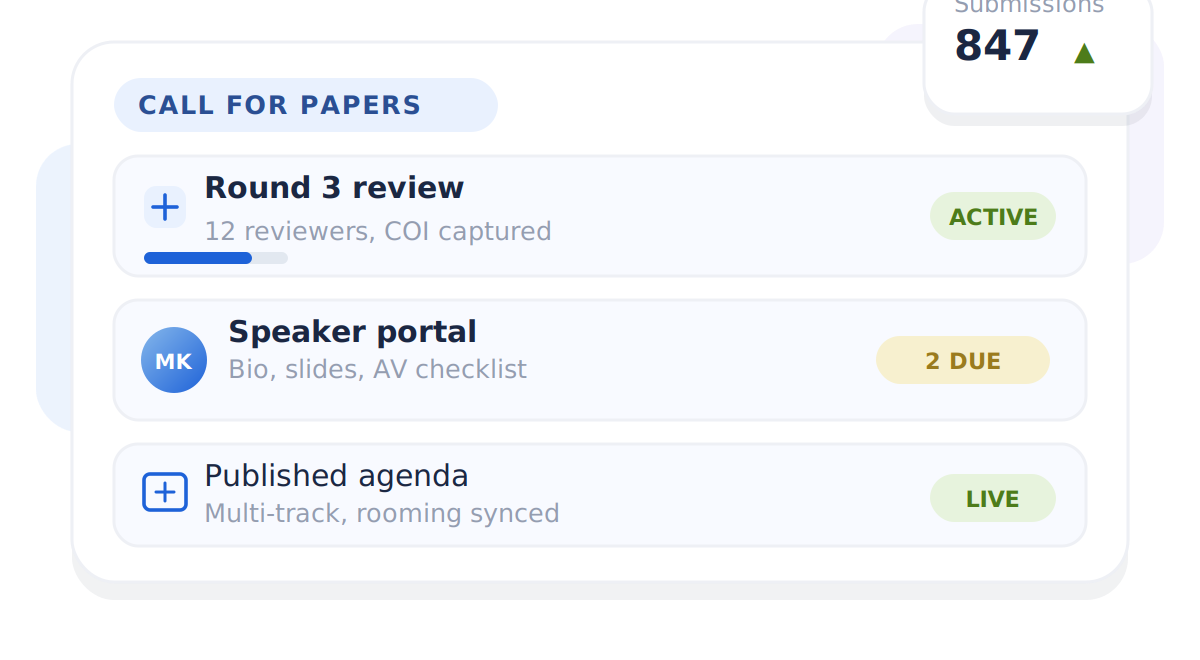






Medical society abstract software handles submission, blind peer review, conflict-of-interest tracking, and disclosure collection for annual meetings. Sessionboard runs the full arc on one record, from call for papers through speaker portal and transcription. CTI/cOASIS serves analyst-run congresses, OpenWater serves form portfolios, and Cadmium routes changes through vendor configuration.
Match your role to the job Sessionboard solves — program ops, content reuse, or marketing attribution.
Chairs and reviewers still coordinate in email — you need committee ops on the program graph, not another submission form.
Speaker data resets every submission cycle — you need one faculty record from acceptance through show day.
Social shares without registration attribution — Advocacy tracks peer links; Dispatch covers internal team distribution.
Transcripts and clips live in a separate tool — you need capture, Attendee Hub, and Create on the session record.
“Sessionboard has been one of our most successful investments this year, making our team more efficient and allowing us to focus on the most critical components of our events.”

“Sessionboard saves significant planning time and makes it easier than ever for speakers and sponsors to participate in our clients' events.”

“We used Sessionboard daily. It served as our source of truth for tracking speakers, sending emails, and accessing reports. The ability to set a weekly digest email was a huge time saver.”
“Honestly, I loved it! Getting everything out of the spreadsheet. It collects all the information and gives you a visual of who you might want to invite.”
No single winner — match the tool to your trigger, data ownership, and team workflow.
| Vendor | Best when | Tradeoffs | Pricing note |
|---|---|---|---|
| Sessionboard | The society wants submission, blind multi-round review, COI and disclosure tracking, speaker portal, and session transcription on one platform the committee configures itself. Faculty history carries across annual meetings in a speaker CRM. | Registration and CE credit remain on your existing systems; Sessionboard runs the program layer beside them. | Licensing follows meeting and submission volume. |
| CTI / cOASIS | A single anchor congress at very large scale runs on analyst-led configuration and the society wants a services relationship rather than self-service software. | Mid-season form and report changes wait on a vendor queue, and speaker operations after acceptance live outside the system. | Services-led, scoped per congress. |
| Cadmium (eventScribe) | The society already runs education and CE products on the Cadmium suite and wants abstracts on the same vendor contract. | Committee changes route through vendor configuration, and the speaker layer beyond review often ends up in email. | Suite pricing across modules. |
| OpenWater | Abstracts share a contract with awards and grants, and forms-plus-review covers the whole requirement. | Post-acceptance workflow, faculty history, and content capture need other tools. | Priced by module breadth. |
Disclosure and conflict-of-interest workflows, committee-tiered blind review, AMS single sign-on for members, and faculty records that persist across years. Generic form tools handle submission; societies need the review governance around it.
Yes, natively: disclosure collection on submission, conflict-of-interest tracking through review, and blind review modes that match society policy. Bring your current workflow to a demo and see it rebuilt live.
In-flight cycles finish where they are. The next call for papers opens in Sessionboard, faculty and acceptance history import, and the committee configures its own forms from day one instead of filing tickets.
That is the point of running it on one record. Sessions carry transcription, captions, and clips, so the program your committee built becomes a member-facing library instead of ending at the closing session.
Not on a platform with one contact graph. Reviewers, judges, faculty, and submitters share identity in Sessionboard, so a member who reviews abstracts and judges awards signs in once and staff see one record.
Talk through your event workflow — abstracts, speakers, content, and marketing on one program graph.
Ready to talk through your workflow?
Request a demo