
★★★★★
“Sessionboard has been one of our most successful investments this year, making our team more efficient and allowing us to focus on the most critical components of our events.”

Every conference program starts with the same machine: announce the call, collect submissions, review them fairly, notify authors, and turn acceptances into sessions.
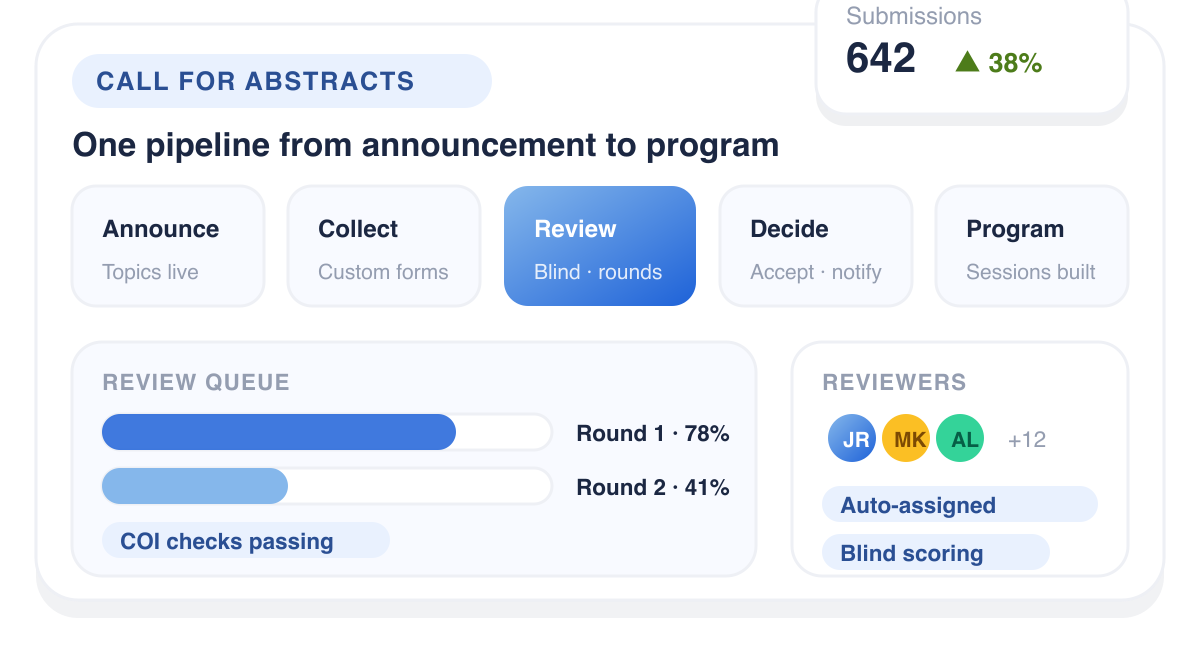














A call for abstracts runs in five stages: announce topics and dates, collect structured submissions, review in scored rounds, notify and confirm presenters, and build the program. Most calls fail in the gaps — vague topics, forms that collect the wrong fields, reviewer chase emails, and acceptance handoffs that fall back to spreadsheets.
The same five stages look different depending on the seat you're in — match the guide to the problem in front of you.
Submissions arrive off-topic and uneven — the announcement and form structure decide review quality before a single reviewer logs in.
Blind review, conflict-of-interest checks, and disclosure collection are requirements, not preferences — the process has to prove fairness.
Acceptance is where the real work starts — confirmations, bios, AV specs, and materials should flow from the same record, not a fresh spreadsheet.
The call is a campaign — announcement copy, deadline pushes, and accepted-speaker promotion all need dates on the same timeline.
“Sessionboard has been one of our most successful investments this year, making our team more efficient and allowing us to focus on the most critical components of our events.”

“Sessionboard saves significant planning time and makes it easier than ever for speakers and sponsors to participate in our clients' events.”

“We used Sessionboard daily. It served as our source of truth for tracking speakers, sending emails, and accessing reports. The ability to set a weekly digest email was a huge time saver.”

“Honestly, I loved it! Getting everything out of the spreadsheet. It collects all the information and gives you a visual of who you might want to invite.”
Match the tooling to submission volume, review complexity, and what happens after acceptance — the stage most setups ignore.
| Vendor | Best when | Tradeoffs | Pricing note |
|---|---|---|---|
| Email + spreadsheets | Under ~50 submissions, one review round, and a committee small enough to meet in one room. | No blind review, version chaos by round two, and every accepted author gets re-keyed into whatever runs the program. | Staff time cost; no platform fee. |
| Form builders (Google Forms, Typeform) | Simple calls where collection is the whole problem — structured fields, one deadline, no scored review. | Review happens in an exported sheet, reviewer assignment and scoring are manual, and nothing persists to the next edition. | Free to low-cost per form. |
| Review-only tools (Ex Ordo, Oxford Abstracts) | Academic conferences where submission and scored review are the full scope and proceedings are the output. | The workflow ends at the decision — speaker confirmations, materials, and program build need another system, and each edition starts from a fresh import. | Priced per conference on submission volume. |
| Suite modules (Cvent, Cadmium) | The call rides along on a suite contract the organization already runs and the workflow fits the module's defaults. | Form and workflow changes route through vendor configuration, and committees wait on queues during the busiest weeks of the season. | Bundled into suite licensing. |
| Sessionboard | The call is the front door to a full program: custom forms the committee edits themselves, auto-assigned reviewers with blind scoring and COI checks across multiple rounds, and acceptance flowing straight into speaker portal, materials, scheduling, and content capture on one record that persists across years. | Built for programs with real review and speaker operations — a ten-abstract seminar doesn't need it. | Licensed by meeting and submission volume. |
The open invitation for prospective presenters to submit session, paper, or poster proposals for review before a conference program is built. Also called a call for papers, call for speakers, or call for proposals depending on the field — the pipeline is the same: announce, collect, review, decide, and build the program.
Eight to twelve weeks is the common window for association and scientific meetings, with the deadline at least four to five months before the event so review, notifications, and speaker confirmations happen before travel booking. Expect a submission spike in the final week regardless of the window.
Everything review and program build need, collected once: title, structured abstract, topic track, preferred format, author and co-presenter details, learning objectives where CE applies, and disclosures. Every field missing at submission becomes a chase email later.
Reviewers are assigned by topic with conflicts of interest excluded, score against a rubric — relevance, rigor, clarity, novelty — often blind to author identity, and the committee decides on ranked results. Larger programs run two rounds: a broad screen, then a program-fit pass.
A call for abstracts asks for the content first — a written proposal reviewed on merit, standard for scientific and educational programs. A call for speakers recruits the person, common for keynotes and industry panels. Many conferences run both against the same program timeline.
The stage most calls fumble: acceptance notifications with confirm-by deadlines, then bios, headshots, AV requirements, disclosures, and presentation uploads. On Sessionboard this flows from the same record into a speaker portal; in spreadsheet setups it becomes a second, error-prone data collection.
Under ~50 submissions, forms and a spreadsheet work. Scored or blind review at volume needs a review tool — Ex Ordo and Oxford Abstracts stop at the decision, suite modules like Cvent and Cadmium depend on vendor configuration, and Sessionboard runs the call plus everything after acceptance on one record.
Talk through your event workflow — abstracts, speakers, content, and marketing on one program graph.
Ready to talk through your workflow?
Request a demo