★★★★★
“Sessionboard has been one of our most successful investments this year, making our team more efficient and allowing us to focus on the most critical components of our events.”

Every vendor in event marketing promises to help you grow your event.
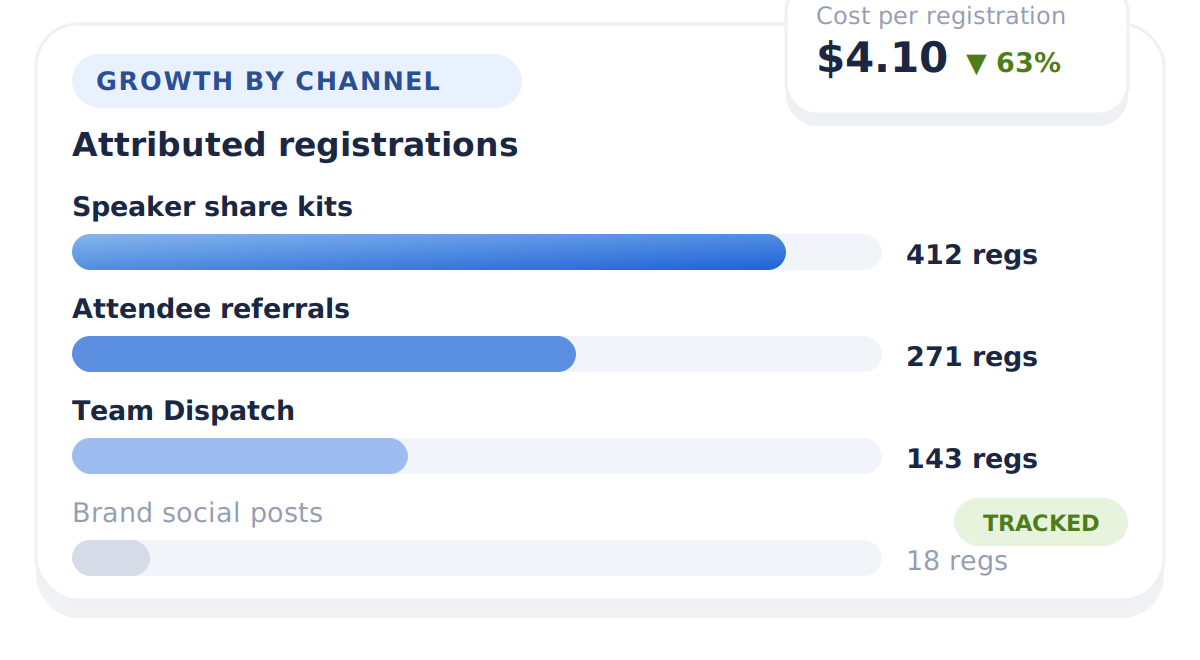

The reliable way to increase event attendance is activating the networks you already own — speakers, authors, attendees, exhibitors, and your team — with tracked share content and registration attribution, so channels are judged on registrations, not impressions. Advocacy tools and referral widgets measure shares; event growth is measured in revenue. This guide ranks the levers by conversion.
Match your role to the job Sessionboard solves — program ops, content reuse, or marketing attribution.
Paid CPCs keep climbing while organic reach falls — the channels that used to fill the room now need a budget line each.
Members and speakers would promote the meeting if promoting it took one click — today it takes a request, a wait, and a generic graphic.
Advocacy tools report impressions and engagement; the CFO asks which registrations came from which channel and nobody can answer.
Employee advocacy platform posts brand content to LinkedIn but knows nothing about the event — no session data, no speaker assets, no registration attribution.
“Sessionboard has been one of our most successful investments this year, making our team more efficient and allowing us to focus on the most critical components of our events.”

“Sessionboard saves significant planning time and makes it easier than ever for speakers and sponsors to participate in our clients' events.”
“We used Sessionboard daily. It served as our source of truth for tracking speakers, sending emails, and accessing reports. The ability to set a weekly digest email was a huge time saver.”
“Honestly, I loved it! Getting everything out of the spreadsheet. It collects all the information and gives you a visual of who you might want to invite.”
The tools that promise to grow your event fall into four camps. Judge each on one question: can it tell you which registrations it produced?
| Vendor | Best when | Tradeoffs | Pricing note |
|---|---|---|---|
| Generic employee advocacy platforms (Vulse, Oktopost, DSMN8) | Your goal is brand reach on LinkedIn — tone-matched posts, scheduling, leaderboards, and engagement analytics for a standing employee program. | No event layer: no session or speaker data, content isn't generated from your program, and success is measured in impressions and clicks — not registrations. You still hand-build every event asset. | Per-user monthly SaaS |
| Event referral widgets (InGo, SnoBall, Gleanin) | Registration-moment social sharing — a 'tell your network' widget on the confirmation step, with referral counting. | Starts and ends at registration: speakers, authors, and session content never enter the loop, and the share asset is a generic banner rather than the person's actual talk. | Per-event or annual license |
| Event photo & AI advocacy (Premagic) | Post-event photo distribution that attendees share because they're in the picture. | Runs after the event, when the registration window is closed — great for memory, structurally late for growth. | Per-event |
| DIY — social buttons and a media kit | Zero budget and a small program where the team can hand-make speaker cards and chase people to post them. | No attribution, no scale, and the asset-making burden lands on the marketing team at their busiest — which is why it stops after week two. | Free, paid for in hours |
| Sessionboard Advocacy + Dispatch | Growth from the program record: personalized share kits for every speaker, author, and attendee generated from real session data, employee share recipes for your own team, and every click tracked to registration. | Event-native by design — it amplifies your event, not a standing corporate LinkedIn program; generic brand advocacy stays with a tool built for that. | Included with the program platform |
Activate the networks the event already owns. Speakers, authors, attendees, exhibitors, and employees collectively reach far more qualified prospects than a paid budget, and their posts carry peer trust that brand accounts don't. The mechanism that makes it work is one-click, personalized share content with registration attribution — so you can see which networks convert and double down.
They help with brand reach on LinkedIn, which is a different job. Generic advocacy platforms don't know your sessions, speakers, or registration flow — every event asset is hand-built, and results are reported in impressions rather than registrations. For event growth you need advocacy generated from the program record with attribution to registration, which is what event-native tooling does.
Referral widgets activate one moment — registration — with one audience, attendees. Sessionboard runs advocacy across the whole program: speakers and authors get personalized share kits from acceptance onward, attendees get prompts on confirmation pages and emails, and your own team gets Dispatch share recipes tied to program milestones. Every link is tracked to registration. They can also coexist — several teams run a registration widget beside Sessionboard's speaker and content advocacy.
Attributed registrations and cost per registration, per channel — the same way you judge paid. Impressions, shares, and engagement are diagnostics, not results. If a channel can't be tied to registrations, you can't compare it to the channels that can, and it will absorb budget on faith.
At acceptance. The window between acceptance and event week is the longest marketing runway the event has, and it's usually wasted because speakers get their share assets two weeks before doors open. Send a personalized share kit with the acceptance email and every speaker becomes a channel for the full runway.
Especially well. Members trust other members more than they trust the association's brand account, and authors promoting an accepted abstract or poster is the most natural advocacy there is. The same tracked-share mechanics also carry member value between meetings — session libraries and poster galleries that members share year-round.
Talk through your event workflow — abstracts, speakers, content, and marketing on one program graph.
Want growth you can attribute?
Request a demo