
★★★★★
“Sessionboard has been one of our most successful investments this year, making our team more efficient and allowing us to focus on the most critical components of our events.”

Cvent is the default suite, and that is exactly why alternative searches spike at renewal time: one contract covers registration, venue sourcing, mobile app, and a speaker and abstract module that…













Most teams searching for Cvent alternatives don't need to replace all of Cvent — they need depth in one job the suite handles thinly. For registration, teams shortlist Swoogo and Bizzabo. For the speaker, abstract, and session content layer, Sessionboard runs call for papers, multi-round review, speaker portal, transcription, and awards beside whichever registration platform stays.
Match your role to the job Sessionboard solves — program ops, content reuse, or marketing attribution.
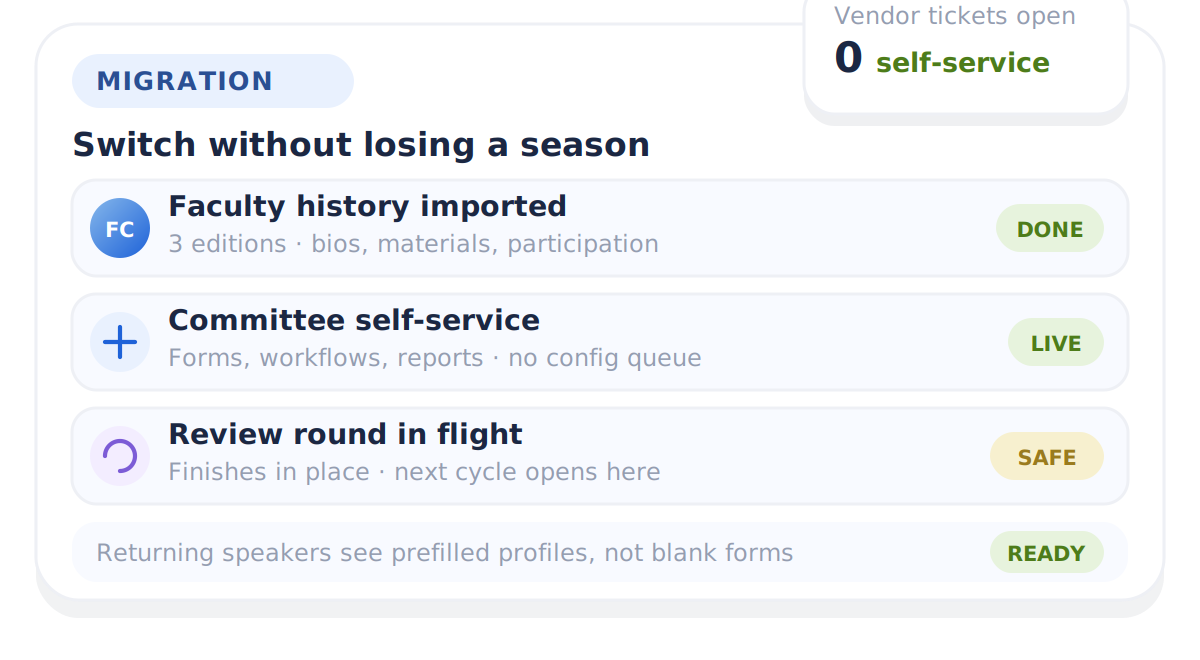
Chairs and reviewers still coordinate in email — you need committee ops on the program graph, not another submission form.
Speaker data resets every submission cycle — you need one faculty record from acceptance through show day.
Social shares without registration attribution — Advocacy tracks peer links; Dispatch covers internal team distribution.
Transcripts and clips live in a separate tool — you need capture, Attendee Hub, and Create on the session record.
“Sessionboard has been one of our most successful investments this year, making our team more efficient and allowing us to focus on the most critical components of our events.”

“Sessionboard saves significant planning time and makes it easier than ever for speakers and sponsors to participate in our clients' events.”

“We used Sessionboard daily. It served as our source of truth for tracking speakers, sending emails, and accessing reports. The ability to set a weekly digest email was a huge time saver.”

“Honestly, I loved it! Getting everything out of the spreadsheet. It collects all the information and gives you a visual of who you might want to invite.”
Cvent is several products in one contract. Compare alternatives per job — registration, event experience, and program operations — instead of hunting for a suite-for-suite swap.
| Vendor | Best when | Tradeoffs | Pricing note |
|---|---|---|---|
| Sessionboard | The speaker, abstract, and content side is what you've outgrown: call for papers, multi-round blind review, speaker portal and readiness, session transcription, a media library, and awards on one program record — with a speaker CRM that persists across years. Runs beside Cvent registration or any alternative you pick. | Not a registration or venue-sourcing platform; that job stays on your existing stack by design. | Licensed by meeting and submission volume; scoped quote in one demo. |
| Swoogo | Registration is the job — flexible self-serve builds, transparent pricing, and a team tired of suite renewals. | Program operations (abstracts, review, speaker materials) sit outside its scope; content workflows need another layer. | Flat annual licensing by user, not per registration. |
| Bizzabo | Event experience end to end — registration, check-in, and attendee engagement for B2B conference portfolios. | Speaker and abstract depth is thin; call for papers and review typically live in forms or a separate tool. | Platform subscription by event volume and features. |
| RainFocus | Enterprise portfolios want one data platform across registration, content, and exhibitor activity with dedicated services. | Services-led configuration and enterprise pricing; program committees still wait on cycles for changes. | Enterprise contracts scoped per portfolio. |
| Stova | Full-service delivery matters more than self-service software — an agency-style partner running registration and onsite tech. | Depth comes from services, not committee self-service; speaker and abstract workflows remain basic. | Services-inclusive engagements scoped per event. |
Depends on the job. For registration, teams shortlist Swoogo and Bizzabo. For enterprise portfolio data, RainFocus. For the speaker, abstract, and session content layer — the module program teams outgrow first — Sessionboard runs call for papers, review, speaker portal, transcription, and awards beside whichever registration platform you keep.
No, and most teams shouldn't. Registration contracts and program operations run on different calendars and serve different owners. Unbundling one job — usually the speaker and abstract side — de-risks the change and gives you leverage at the next registration renewal.
For speaker, abstract, and content management, yes — that is the lane where Sessionboard goes deeper than the suite: multi-round blind review, speaker CRM across years, session transcription, and awards on one record. For registration and venue sourcing, no; Sessionboard runs beside Cvent or any alternative.
Usually the speaker and abstract workflow. Complex programs need multi-round review, conflict-of-interest tracking, speaker readiness, and content capture — jobs the suite covers thinly — while registration keeps working fine. That is why replacing the program layer first is the common move.
Yes. Registration stays where it is; Sessionboard owns the program record — submissions, review, speakers, materials, transcription — and the two sides exchange the data they need. Many customers run exactly this split.
Swoogo publishes flat annual licensing; the others quote by scope. The honest comparison is your suite renewal against the unbundled stack you'd actually run — registration plus program layer — priced line by line before you sign.
Talk through your event workflow — abstracts, speakers, content, and marketing on one program graph.
Ready to talk through your workflow?
Request a demo