
★★★★★
“Sessionboard has been one of our most successful investments this year, making our team more efficient and allowing us to focus on the most critical components of our events.”

A call for speakers is the cheapest way to fill a program with people who actually want to be there — and the fastest way to bury your team in unusable applications.
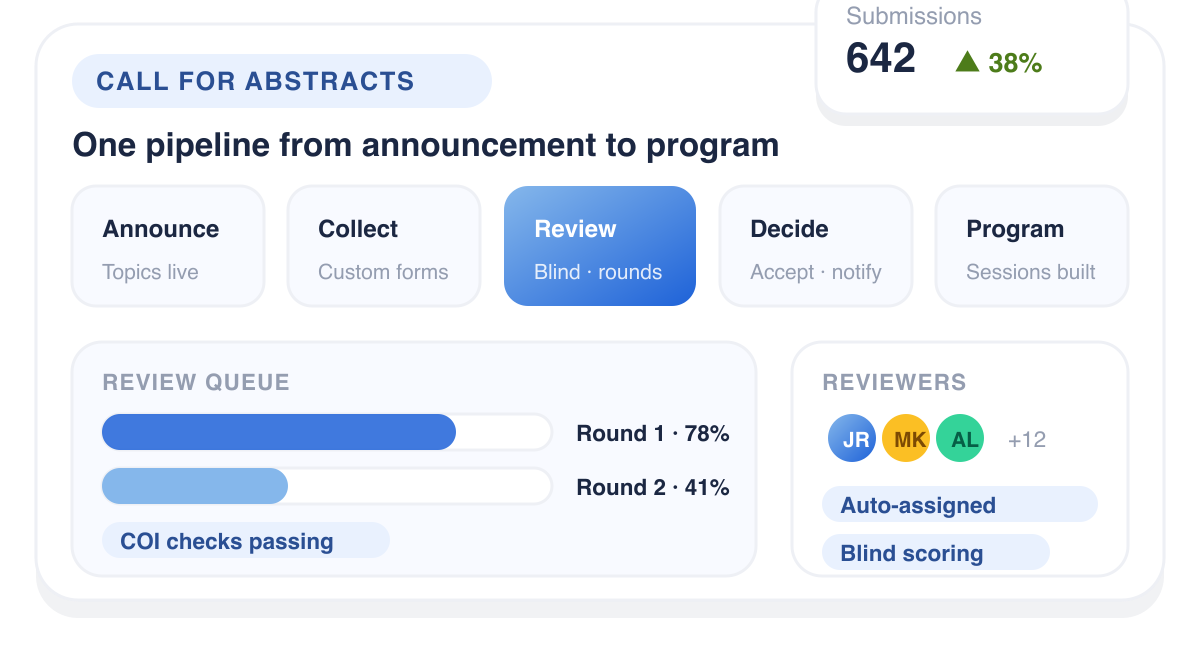
















A call for speakers is an open invitation for people to propose themselves as presenters at an event. Running one takes five stages: publish topics and criteria, collect structured applications, score them against a rubric, notify and confirm those you pick, then collect bios and materials. Unlike a call for abstracts, it recruits the person rather than reviewing written research.
The same five stages look different depending on which seat you are in — match the guide to the problem in front of you.
You need a program that sells tickets — the call has to attract recognizable speakers, not just willing ones.
Applications arrive uneven and off-topic — the criteria and form decide review quality before anyone starts scoring.
Selection is where the work starts — confirmations, bios, headshots, AV needs, and deadlines all land on you.
You run a call every cycle with a volunteer committee and no budget — it has to be repeatable without a platform contract.
“Sessionboard has been one of our most successful investments this year, making our team more efficient and allowing us to focus on the most critical components of our events.”

“Sessionboard saves significant planning time and makes it easier than ever for speakers and sponsors to participate in our clients' events.”

“We used Sessionboard daily. It served as our source of truth for tracking speakers, sending emails, and accessing reports. The ability to set a weekly digest email was a huge time saver.”

“Honestly, I loved it! Getting everything out of the spreadsheet. It collects all the information and gives you a visual of who you might want to invite.”
Match the tooling to how many applications you expect, whether a committee scores them, and what has to happen between selection and show day.
| Vendor | Best when | Tradeoffs | Pricing note |
|---|---|---|---|
| Email + a spreadsheet | Under ~40 applications, one decision-maker, and a program small enough to hold in your head. | No scoring trail, no blind review, and every selected speaker gets re-keyed into whatever runs the program. | Staff time only; no platform fee. |
| Form builders (Google Forms, Typeform) | Collection is the entire problem — structured fields, one deadline, and a decision made in a single meeting. | Review happens in an exported sheet, reviewer assignment and scoring are manual, and nothing carries to next year. | Free to low-cost per form. |
| Speaker-sourcing platforms (Sessionize) | Developer, tech, and community conferences that want distribution to an existing speaker audience alongside the call itself. | Strongest for the submission and selection window; program operations, materials chase, and marketing live elsewhere. | Free for many community events; paid tiers for commercial conferences. |
| Suite modules (Cvent, Cadmium) | The call rides along on a registration suite the organization already licenses and the default workflow fits. | Form and scoring changes route through vendor configuration, so committees wait on queues in the busiest weeks. | Bundled into suite licensing. |
| Sessionboard | The call is the front door to a real program: application forms the committee edits itself, scored review with assignment rules, and selection flowing straight into speaker portal, materials, scheduling, and promotion on one record that persists across years. | Built for programs with genuine review and speaker operations — a single-track meetup does not need it. | Licensed by meeting and volume. |
An open invitation for people to propose themselves as presenters at an event. Organizers publish the topics, formats, and dates they are looking for, collect applications through a form, score them against criteria, and select a lineup. It is also called a call for proposals or a call for presenters.
A call for speakers recruits the person — common for keynotes, panels, and industry conference tracks, where prior speaking ability matters. A call for papers or abstracts asks for the content first as a written proposal reviewed on merit, standard for scientific and academic programs. Many conferences run both against one program timeline.
Four to eight weeks is typical, with the deadline three to five months before the event so selection, confirmations, and travel booking all have room. Expect most applications in the final seventy-two hours no matter how long the window is.
Session title, the specific thing an attendee will be able to do afterward, preferred format and length, topic track, a short bio, and evidence of prior speaking such as a recording or past event. Ask about commercial interest directly, and collect anything the program needs later so you are not chasing it in month three.
Write the criteria before the call opens — relevance to the track, clarity of the takeaway, evidence the person can deliver, and lineup balance — then score every application against them, ideally with more than one reviewer. A written rubric is what lets you answer a declined applicant honestly.
Through event websites directly, speaker platforms and listing sites, association and chapter newsletters, and community roundups in their field. If you are applying, follow the stated format exactly and lead with the concrete takeaway rather than your biography.
For small calls, a form and a spreadsheet genuinely work. At volume, or when a committee scores applications, you need assignment and scoring in one place — Sessionize is strong for sourcing and selection in tech and community events, suite modules like Cvent depend on vendor configuration, and Sessionboard runs the call plus everything after selection on one record.
Practice varies by field: association and community events often cover travel only, while commercial conferences pay keynotes and not breakout speakers. Whatever you do, state it in the announcement — unstated compensation is the most common reason a selected speaker withdraws late.
Talk through your event workflow — abstracts, speakers, content, and marketing on one program graph.
Ready to talk through your workflow?
Request a demo