
July 28, 2026

6
min read
Best abstract management software for conferences in 2026
How to shortlist abstract management software — updated for 2026 buyers.


How to shortlist abstract management software — updated for 2026 buyers.
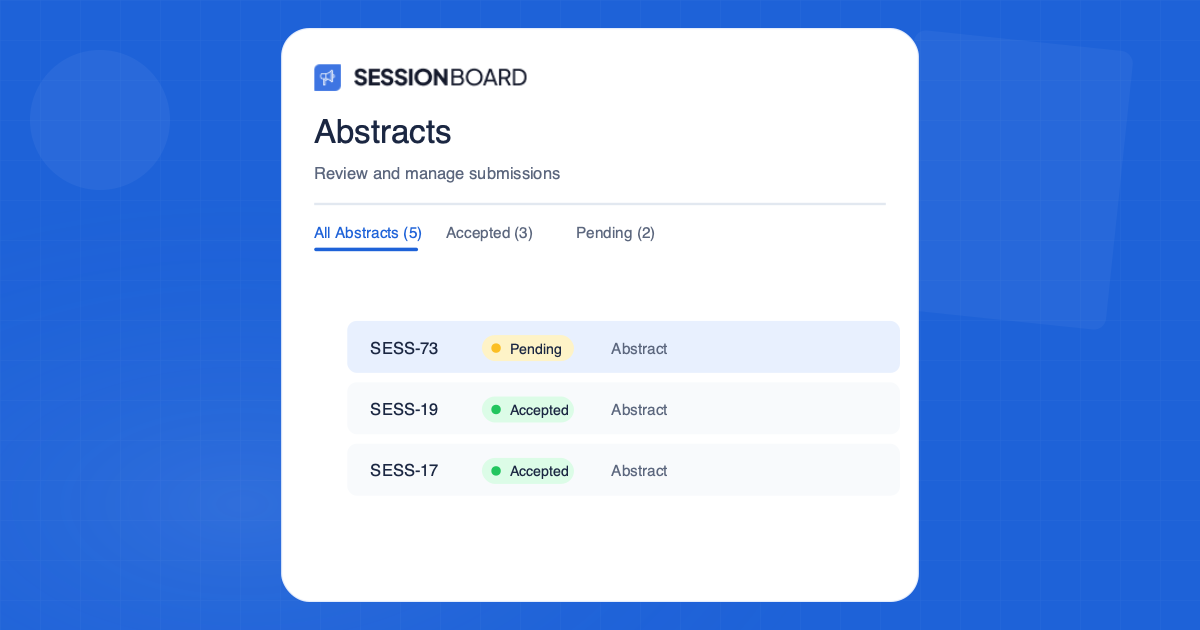
Abstract management software is the platform your team uses to collect submissions, run peer review, and build a program from accepted content. The right tool saves weeks of operational work. The wrong one creates more manual cleanup than it eliminates.
This guide compares 10 abstract management platforms across the features that actually determine whether the software works for your program: submission flexibility, review workflow depth, the handoff from accepted abstract to scheduled session, pricing transparency, and fit for different event types. Every tool on this list is actively maintained and used by real conference teams in 2026.
We assessed each platform against five criteria that matter most to teams managing abstract programs at scale:
Submission flexibility. Can you define different submission types (abstracts, posters, full sessions, panels)? Can you collect participant roles (authors, co-authors, custom roles) directly in the form? Are payments supported natively?
Review workflow depth. Does the platform support multi-round evaluation with independent scorecards per round? Can you configure anonymization, reviewer assignment limits, and track completion in real time?
Abstract-to-session workflow. When an abstract is accepted, does it become a schedulable session automatically — with all metadata intact? Or does your team re-enter the data?
Integrations and ecosystem. Does the tool connect to your event management platform, AMS, or other systems your organization already uses?
Best for: Associations and enterprise teams running multi-stage abstract programs
Sessionboard is built around a distinction most platforms skip: abstracts and sessions are different things. Abstracts are proposals that live in the review pipeline. Sessions are finalized, agenda-ready items. The platform manages both as separate entities and handles the transition between them automatically when a submission is accepted — no re-entry, no lost metadata.
The evaluation system supports multi-round peer review natively. Each round gets its own scorecard (numeric ratings, dropdowns, text feedback, file uploads), anonymization settings, open/close dates, and reviewer pool. Reviewers access a dedicated portal via magic link — no admin accounts required. Assignment controls let admins set maximum reviews per evaluator and per submission, preview all assignments before confirming, and track progress in real time.
Submission payments are built into the form with 100+ payment gateways supported and zero platform transaction fees. Custom participant roles (author, co-author, panelist, or any label your program uses) are collected at submission and carried through to the program builder.
Sessionboard integrates with association management systems (iMIS, Personify, Fonteva) and event platforms (Cvent, Swoogo, Accelevents, Bizzabo), making it particularly well-suited for organizations that need abstract management integrated with their existing tech stack.
Strengths: Abstract-session lifecycle management, multi-round review with custom scorecards, native submission payments with no platform fees, AMS integrations, dedicated reviewer portal.
Considerations: New entrant in the abstract management space; strongest fit for associations and enterprise teams rather than small academic departments.
Pricing: Talk to Sales.
How the American Urological Association Modernized Speaker, Abstract, and Content Management
Best for: Academic conferences and research events
Oxford Abstracts is a dedicated academic conference platform with strong abstract management at its core. The submission and review workflow is clean and well-designed, with support for multi-stage review, symposia management, and a recently launched reviewer assignment tool that automates distribution based on rules you define.
The platform has expanded beyond pure abstract management to include a website builder, delegate registration, and a conference platform for virtual and hybrid delivery. Transparent pricing and a free tier make it accessible for smaller events.
Strengths: Purpose-built for academic conferences, transparent pricing (from approximately $800), free tier available, 4.9-star Trustpilot rating, clean interface.
Considerations: Primarily designed for academic events, the feature set may be less aligned with associations and corporate conferences. Multi-stage and symposia features are paid add-ons.
Pricing: Published on the website, starting from approximately $800
Best for: Scientific, medical, and technical conferences
Ex Ordo focuses on the research conference workflow: abstract collection, peer review, program building, and virtual conferencing. The system has strong peer-review capabilities, including automatic reviewer-submission matching and support for single- and double-blind review. In 2025, an infrastructure overhaul modernized the platform.
The panels and symposia feature multi-speaker sessions within the review workflow. Registration and virtual conferencing are included, making it an all-in-one option for academic event teams.
Strengths: Strong peer review workflow, automatic reviewer matching, panels and symposia support, modern interface after 2025 update
Considerations: No transparent pricing — you must book a demo to get costs. Primarily virtual-event focused; less clear support for hybrid or in-person logistics.
Pricing: Contact provider
Best for: Mid-sized conferences that need abstract management within a broader event platform
Whova is a comprehensive event management platform that includes abstract management as one component of a larger toolkit (registration, event app, networking, exhibitor management). The call for speakers system handles submission collection, reviewer assignment, scoring, and integration with the event agenda.
Recent upgrades include expanded review controls, custom submission tags and filters, and improved agenda integration tied to abstract acceptances. The platform is widely used across corporate, association, and academic events.
Strengths: Full event management ecosystem, agenda integration, reusable call-for-speakers settings, broad feature set beyond abstract management
Considerations: Abstract management is one feature among many — not the core focus. Some reviews note that the abstract management tooling is less robust than dedicated platforms. No transparent pricing.
Pricing: Contact provider
Best for: Associations and nonprofits running events with continuing education components
Cadmium's Eventscribe platform combines event management with abstract submission and review, plus a unique strength in learning management and continuing education (through their EthosCE and Elevate LMS products). The abstract management workflow includes customizable submission forms, reviewer assignments, a scoring system, and notifications.
For associations that need to connect event content to CE credit management, Cadmium offers an integrated path that most competitors don't.
Strengths: CE/CME integration through LMS products, task-based event management, strong association focus, full event management suite
Considerations: Some user reviews note a dated interface with a learning curve. No transparent pricing.
Pricing: Contact provider
Best for: Organizations managing abstracts alongside awards, grants, and fellowships
OpenWater is a versatile platform that spans abstract management, awards programs, grants, scholarships, and fellowships. If your organization runs multiple program types — not just conference abstracts — OpenWater's flexibility across use cases is a differentiator.
The abstract management workflow includes conditional logic forms, multi-round peer review, session building, and branded submission websites. A 2025 update introduced AI-powered submission analysis and scoring, plus a refreshed interface.
Strengths: Multi-program versatility (abstracts + awards + grants), conditional logic forms, AI submission analysis, session builder
Considerations: Primary strength is awards/grants — abstract management is one use case, not the core focus. No transparent pricing or free trial.
Pricing: Contact provider
Best for: Academic and scientific conferences, particularly poster-focused events
Fourwaves is a Canadian company focused on academic and scientific event management. The platform handles abstract submissions, peer review (single-, double-, and blind), event registration, website creation, and poster sessions — including virtual poster presentations with live video discussions.
The interface is clean and straightforward, with recent improvements to certificate workflows, peer review processes, and track management. A free tier and published pricing make it accessible for university departments and smaller research events.
Strengths: Strong poster session support with virtual video discussions, a clean interface, published pricing (from $899), a free tier, and a good fit for smaller academic events.
Considerations: Feature set is lighter for large-scale or enterprise programs. Some reviews note confusion about usability for new users.
Pricing: Published on website, starting from $899
Best for: Large corporate events with abstract management as part of a broader event strategy
Cvent is a major event management platform that includes abstract management through its Call for Papers process. The platform covers the full event lifecycle — from venue sourcing to attendee engagement — with abstract management as one component. For organizations already in the Cvent ecosystem, adding abstract management keeps everything in one platform.
Recent updates include improved workflow templates, reviewer configurations, and automated email communications within the review process.
Strengths: Comprehensive event management ecosystem, venue sourcing, enterprise-scale infrastructure, familiar to teams already using Cvent
Considerations: Expensive compared to dedicated abstract management tools. Long-term contracts are common. The abstract management module is one feature within a massive platform — smaller teams may find it overly complex.
Pricing: Contact provider (typically enterprise pricing)
Best for: Academic institutions and university conferences on a budget
Dryfta is an event management platform with a dedicated abstract management module aimed at academic and university conferences. It supports custom submission workflows for abstracts, symposia, proposals, and grants, with both automated and manual reviewer assignment. A 2025 update added AI-powered plagiarism detection and improved bulk download for review files.
The platform publishes starting prices, which is uncommon in this category. The small-event package starts at $1,499 and includes two free training sessions.
Strengths: Budget-friendly starting price, plagiarism detection, academic focus, training included, custom submission workflows
Considerations: Steeper learning curve in some areas. Some reviews note the interface can feel unintuitive initially. Limited export formats (PDF and CSV only). May struggle at a larger scale.
Pricing: Published starting from $1,499
Best for: Large-volume academic and scientific events with complex abstract programs
Morressier specializes in abstract and poster management for academic and scientific events. The platform handles high-volume submission programs with auto-assigned reviewers, automated notification workflows, and analytics dashboards. It also supports journal submission management, making it relevant for organizations that bridge conference presentations and publication pipelines.
Strengths: High-volume submission handling, journal submission management, analytics dashboard, and auto-assigned reviewers.
Considerations: Focused primarily on academic and scientific use cases. Less suited for corporate or association events outside the research context. Limited public information on pricing and recent platform updates.
Pricing: Contact provider
The right platform depends on your program's complexity, the depth of your review process, and how tightly abstract management needs to connect to the rest of your event workflow. Here are the questions that separate tools built for real programs from tools that bolt on a submission form.
How complex is your review process? If you run a single-round review with a small committee, most tools will work. But if your program requires multi-round, blind peer review — with independent scorecards per round, configurable anonymization, reviewer assignment limits, and real-time progress tracking — you need a platform that supports this natively. Sessionboard's evaluation system was built for exactly this: each round gets its own scorecard, timeline, anonymization settings, and reviewer pool, with a dedicated reviewer portal that requires no admin accounts or onboarding.
Do you need abstracts and sessions to be separate? This is the question most teams don't think to ask until they're deep in program building. If your committee evaluates proposals before they become agenda items — or if multiple abstracts get combined into a single session — your software needs to treat abstracts and sessions as distinct entities. Sessionboard is the only platform on this list that manages both as separate objects with their own forms, views, and lifecycle stages, and handles the transition automatically when a submission is accepted. No re-entry, no lost metadata, no spreadsheet bridge.
What does your tech stack look like? Abstract data that lives in a silo creates manual work downstream. If you're an association running an AMS like iMIS, Personify, or Fonteva, or an event team on Cvent, Swoogo, Accelevents, or Bizzabo, the abstract management tool needs to connect. Sessionboard integrates with all of these — so accepted abstracts, speaker data, and program content flow into your existing systems without export-import cycles.
What's the primary event type? Academic and scientific conferences have specific needs — blind review, poster sessions, publication pipelines — that platforms like Oxford Abstracts and Ex Ordo handle well. But association annual meetings and medical society conferences add additional complexity: multi-track programs built from hundreds of submissions, AMS integration, submission fees, committee-driven decisions across multiple rounds, and content that flows from abstract acceptance through to a published agenda. That's the workflow Sessionboard was designed around.
How much manual work happens after acceptance? This is the question most teams forget. Even if your submission and review process works well, the gap between "this abstract was accepted" and "this session is on the agenda" is where hours get lost. If your current tool requires you to re-enter accepted abstracts into a program builder — or copy-paste metadata between systems — that's a workflow problem the software should solve, not create.
Abstract management software is a platform that handles the full lifecycle of content submissions for conferences and events: collecting abstracts through structured forms, routing them through peer review, making acceptance decisions, and organizing accepted content into a program or agenda. It replaces email-based submission collection and spreadsheet-based review tracking.
For academic conferences, Oxford Abstracts and Ex Ordo are purpose-built options with robust peer-review workflows. Fourwaves is a good fit for smaller academic events and poster-focused conferences. For larger academic programs that need the abstract-to-session workflow and AMS integration, Sessionboard is built for that complexity.
Sessionboard and Cadmium (Eventscribe) are the strongest options for associations. Sessionboard handles the lifecycle of abstract sessions natively and integrates with association management systems. Cadmium adds continuing education and LMS capabilities that some associations need.
Pricing varies significantly. Oxford Abstracts starts from approximately $800 with a free tier. Fourwaves starts at $899. Dryfta starts at $1,499. Most platforms — including Sessionboard, Cvent, Whova, Ex Ordo, and OpenWater — require a sales conversation for pricing.
Yes — most platforms built for academic or medical programs support single-blind and double-blind review. The better systems let you configure anonymization per review round rather than globally, so initial screening can be blind while committee discussion has full visibility.
Not always, but the abstract management capability needs depth. Platforms like Whova, Cvent, and Cadmium include abstract management as part of a broader event suite. Dedicated tools like Oxford Abstracts, Ex Ordo, and Sessionboard focus on the submission-to-program workflow with more depth. The best approach depends on whether your program's complexity demands specialized tooling or whether a lighter module within your existing event platform is sufficient.
Compare Sessionboard vs Cadmium · Compare vs OpenWater · Request a demo
.png)

Stay up to date with our latest news
See how real teams simplify speaker management, scale content operations, and run smoother events with Sessionboard.
