
July 26, 2026

3
min read
Best abstract management software for conferences (2026)
Honest 2026 buyer guide to abstract management software for associations and med/sci…


Honest 2026 buyer guide to abstract management software for associations and med/sci…
"Abstract management software" spans everything from a Google Form with mail merge to enterprise peer-review platforms processing thousands of med/sci submissions per cycle. The right choice depends on programme complexity, not feature count on a marketing page.
Use this 2026 guide to shortlist vendors without paying for suite breadth you will not use, or buying a lightweight tool that breaks at deadline week.
Ask vendors what happens when 2,000 authors submit in 36 hours. You want queueing, idempotent submits, and support playbooks, not "scale your browser window."
After acceptance, does the abstract ID survive into session scheduling, speaker management, website content, and credit exports (med/sci)? If the answer is CSV export and prayer, budget integration time every year.
Associations run the same committee structure annually. Templates for tracks, rubrics, email templates, and role assignments save more time than AI copy on a landing page.
Volunteer reviewer hours are real cost. Clunky UX shows up as late scores, chair chasing, and programme delays, not as a line item on your PO.
Built for abstract to session to speaker to content workflows on complex recurring events.
Sessionboard fits associations and med/sci teams that treat abstracts as operational data connected to credits, awards, and live schedule state, not a once-a-year form project.
Best when: multi-track review, accreditation, awards overlap, or Cadmium/OpenWater displacement with tighter programme ownership.
Platforms like Cvent, Cadmium, and similar suites bundle registration, abstracts, and expo tooling.
Best when: you want one vendor contract and abstract volume is moderate; committee workflow is simple; you accept export-based handoffs to scheduling.
Watch for: abstract modules that lag registration UX; reviewer experience as a bolt-on; med/sci credit as a professional services project.
OpenWater and peers excel at structured application review, scoring rubrics, and public-facing submission portals, common in associations and scientific societies.
Best when: review scoring is the hard problem and post-acceptance programme ops are lighter.
Watch for: schedule and speaker lifecycle after acceptance. Confirm whether your team needs a second system.
Forms plus spreadsheets, or low-cost portals for under 100 submissions.
Best when: single track, no blinding, no credit linkage, same volunteers every year who tolerate friction.
| Scenario | Start here |
|---|---|
| Med/sci multi-track + credits | Sessionboard, specialist med/sci references |
| Association annual meeting, 500–2K abstracts | Sessionboard, OpenWater, suite module compare |
| Corporate user conference, under 200 talks | Suite module or lightweight portal |
| Awards + abstracts same committee | Sessionboard (shared programme record) |
| Displacing Cadmium abstract module | Sessionboard vs Cadmium |
We do not publish a fake "Top 10" with pay-to-play ordering. The list above is scenario-based, the way buyers actually decide.
Sessionboard is not trying to be registration, expo floor planning, and hotel block software. It is the programme spine for teams where:
That specialist focus is why med/sci and association teams evaluating suite bundles still run a structured compare against OpenWater and Cadmium.
End-to-end call-for-papers: intake, review, decisions, notifications, and on full platforms, linkage to scheduling and published content.
Event software centers registration and logistics; abstract software centers peer review and programme committee operations.
Multi-track review, accreditation, recurring annual programmes, or high submission volume, typically 200+ submissions or complex committee rules.


Stay up to date with our latest news

Most med/sci abstracts land in the final 48 hours. What breaks and how teams prepare.

Honest 2026 buyer guide to abstract management software for associations and med/sci…
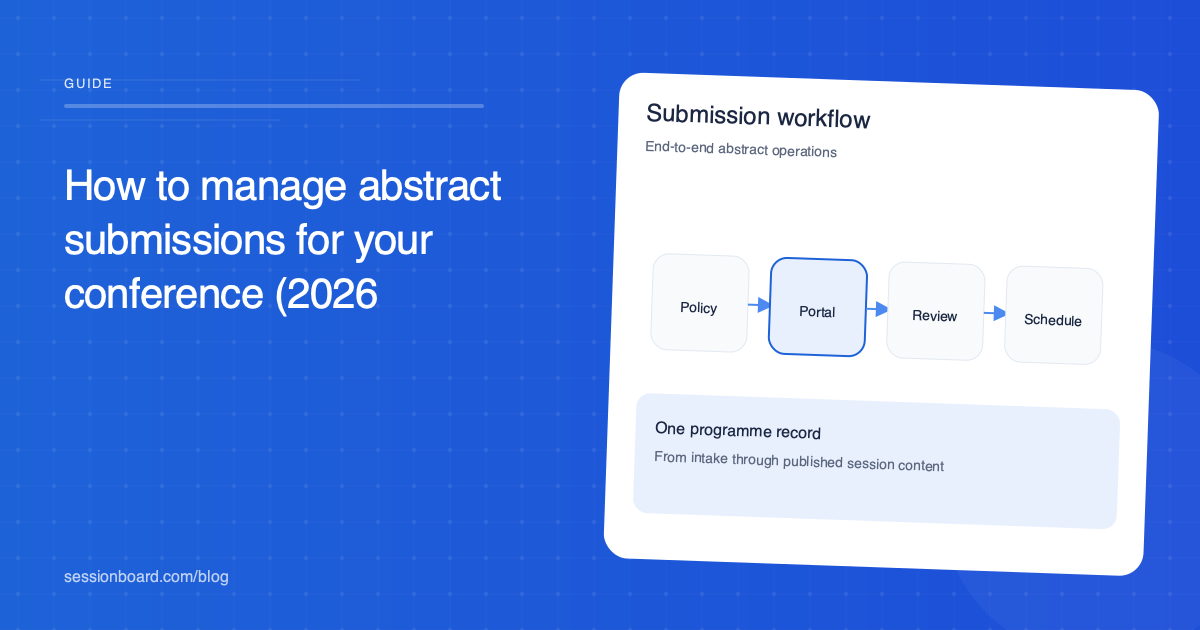
A practical 2026 guide to managing conference abstract submissions without spreadsheet…
See how real teams simplify speaker management, scale content operations, and run smoother events with Sessionboard.
