
July 28, 2026

3
min read
Post-Event Content Strategy: Turn One Event Into A Year Of Content
Plan post-event content before doors open — the window is days, not months.


Plan post-event content before doors open — the window is days, not months.
A post-event content strategy is the plan for what happens to your event's content after the event ends — how every session, transcript, and speaker moment gets turned into marketing content, on what timeline, and toward what goal. Most teams don't have one. They run a sophisticated content operation right up to the event, then let it go quiet the week after.
That gap has a cost. Speaker sourcing runs for months. Abstracts get written, decks reviewed, rehearsals run. A single enterprise event can cost between $0.5M and $5M to produce. Then, roughly two weeks later, the recordings are sitting on a platform, the decks are archived in a drive, and marketing is brainstorming its next campaign from scratch — while sitting on a library of expert, audience-validated content produced weeks earlier at enormous expense. It's not a single failure point. It's an absence: no owner, no workflow, no timeline, no system connecting event content to marketing.
A post-event content strategy defines three things: what content you'll create from the event, when you'll publish it, and what job each piece needs to do. The raw material already exists the moment your event ends — you're not creating from nothing, you're activating what you already produced.
The distinction that matters is between a content calendar and a content strategy. A calendar that starts when registration opens and goes quiet after the closing keynote isn't a strategy — it's a sprint. A post-event content strategy treats the event as the beginning of the content cycle, not its end.

Most event content gets wasted because nobody owns the handoff. On one side sits event content — well managed: speakers, sessions, decks, transcriptions. On the other side sits marketing — separately managed: campaigns, demand gen, pipeline, the content calendar. Between the two, there's no defined workflow, so the content simply stops moving. The event team's scope ends at delivery; the marketing team's scope begins at content creation. Identifying the best content, extracting the key insights, and reformatting it for channels fall in between — assigned to no one, or handed to a junior team member with no authority, or to a consultant with no institutional knowledge.
The numbers bear this out. Around 75% of organizations repurpose less than half of their event content, and 57% repurpose less than a quarter. More than 40% have no year-round content workflow at all. The content isn't missing — it's operationally invisible. It exists, it's high quality, and no system surfaces it back to the people who need it.
There's a second reason, and it's about trust. Event content is some of the highest-value content an organization creates. It's expert-led, delivered live to a real audience, and validated by the fact that people showed up. That's the opposite of generic, AI-generated filler. Letting it decay after two weeks means throwing away your most credible content while paying to produce weaker content to replace it.
A single event's sessions can yield months' worth of assets across formats. The trick is to start from what was actually said on stage and let each session fan out into multiple pieces.
Written content. Session transcriptions become the source for blog posts, recap articles, thought-leadership pieces, and white papers. Because the words came from a subject-matter expert on stage, the content carries authority a blank prompt never will.
Social and short-form. Meaningful quotes and clips pulled from sessions become LinkedIn posts, quote cards, and carousels. A single keynote can seed weeks of social content.
Email and nurture. Session themes map to nurture sequences and newsletter content that keep the event's audience engaged long after they've gone home.
Sales enablement. Snippets and clips relevant to specific topics can be routed to internal teams — sales, in particular — so the content works in the pipeline, not just awareness.
Plan your post-event content before the event happens, not after. The teams that repurpose the most content decide during planning which sessions map to which marketing goals — so that when the event ends, the workflow is already defined and the only question is execution.
Waiting until after the event is what creates the two-week graveyard. By then, momentum is gone, the team has moved to the next fire, and the content that felt urgent during the event feels like backlog. A 90-day post-event content plan, mapped before the doors open, is what keeps one event creating value all year.
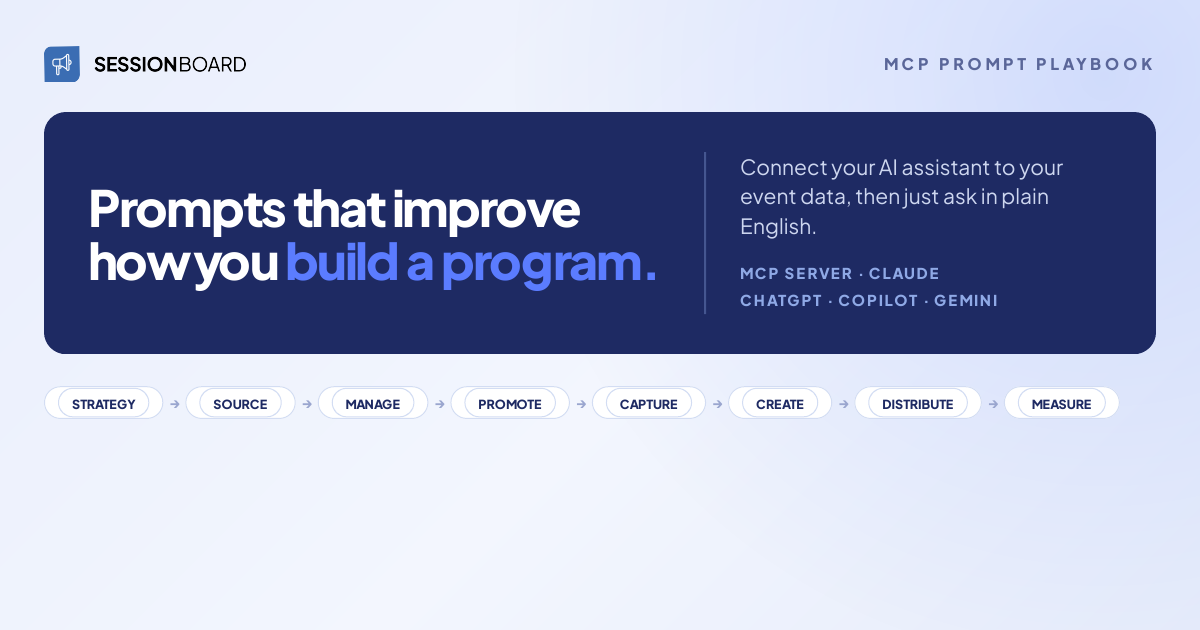
A working post-event content workflow moves in a loop, not a straight line. Content gets captured, organized, turned into assets, planned into a schedule, distributed, and measured — and what you learn from measurement feeds the next cycle.
The first step is turning raw sessions into structured, searchable material. Transcriptions do this: every session becomes text you can search, quote, and repurpose, rather than a video file nobody has time to scrub through. From there, the content gets organized into a single library, enriched with who spoke, what they covered, and which event it came from. Then assets get created from that material, organized into a coordinated plan toward the next goal, and pushed out. Finally, performance gets measured so the next plan starts smarter.
The reason most teams can't run this loop isn't effort — it's that their content lives in disconnected tools that don't talk to each other. The workflow breaks at every handoff.
Sessionboard's Enterprise Content Marketing Platform connects the entire event content lifecycle in one open platform — from capturing sessions through distributing and measuring the content that comes out of them. Instead of managing scattered files, teams build a living, connected network where every transcription, clip, quote, and speaker profile stays linked to the people, topics, sessions, and events behind it. That network is the Content Graph, and it gets richer with every event you run.
Specifically for post-event content, three stages carry the load. Transcriptions turn every session into structured, searchable text — the raw material for everything downstream. The Create stage generates ready-to-use assets (blog posts, LinkedIn posts, quote cards, emails, white papers) grounded in your own brand voice and your own trusted event content, not a generic prompt. The Plan stage then organizes those assets into a coordinated content plan — like a 30/20/10-day countdown to your next webinar or event — pre-populated from what you've already created, so marketing never starts from a blank calendar.
See how Sessionboard turns your event sessions into a year of marketing content. [Request a demo]
A post-event content strategy is a plan for turning an event's sessions, transcriptions, and speaker moments into marketing content after the event ends. It defines what content to create, when to publish it, and what each piece is meant to accomplish across the months following the event.
As much as the content earns — but the practical benchmark is to repurpose meaningfully more than most teams do. Around 75% of organizations repurpose less than half of their event content, so even reaching a majority of your sessions puts you ahead of the field.
Plan for at least 90 days of post-event content. A single enterprise event produces enough expert material to fuel a full quarter of blog posts, social content, email, and sales enablement if it's captured and organized properly.
A content calendar is a schedule of what to publish and when. A post-event content strategy is the larger plan that decides what content to create from the event, why, and toward what goal — the calendar is one output of it.
Because there's usually no owner or workflow connecting event content to marketing. The content is created and stored, but no system surfaces it back to the marketing team, so it becomes operationally invisible within about two weeks.
Blog posts, recap articles, and white papers from transcriptions; quote cards, clips, and carousels for social; newsletter and nurture content from session themes; and sales enablement snippets routed to internal teams. One session can produce assets across all of these formats.
Planning content for your next event? Sessionboard keeps your sessions, speakers, and marketing content connected — from capture through distribution. [Request a demo]
.png)

Stay up to date with our latest news
See how real teams simplify speaker management, scale content operations, and run smoother events with Sessionboard.
