
January 11, 2026

9
min read


For many B2B marketing teams, speakers are treated as a last-minute operational problem:
At Docebo, the marketing team recognized something deeper: their speakers—internal SMEs, customers, partners, and trusted industry voices—were one of their most underutilized marketing assets.
That realization became the catalyst for a fundamental shift in how Docebo approaches thought leadership, events, content, and go-to-market activation.
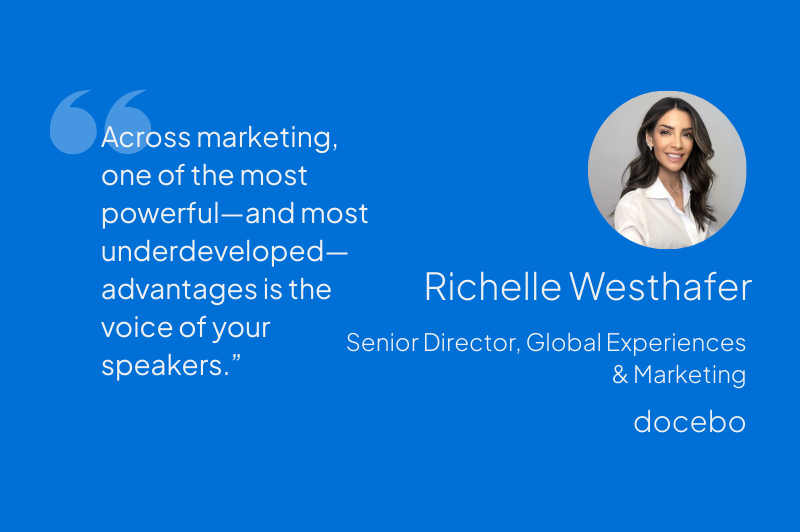
As Richelle Westhafer, Senior Director, Global Events and Experience Marketing at Docebo, shared on Linkedin:
.png)
This case study explores how Docebo moved from reactive speaker sourcing to a deliberate, scalable speaker ecosystem—and why speaker management is now viewed as a core marketing capability.
Docebo had no shortage of expertise:
The challenge wasn’t access—it was visibility, structure, and activation.
Speaker knowledge lived everywhere:
Each program—events, webinars, ABM, partner marketing, field initiatives—was treated as a standalone effort. Speakers were sourced transactionally instead of strategically.
This created familiar challenges:
As Richelle and her team stepped back, they began asking different questions:
Answering those questions required more than process tweaks. It required new infrastructure.
The shift didn’t start as a sweeping transformation. It started with a real operational need.
As Docebo prepared for Inspire, their largest global program, the team needed a more efficient way to manage speakers, sessions, and communications at scale.
That’s when Limor Baum surfaced Sessionboard as a potential solution.
“She brought it forward to solve a real operational challenge—and she was absolutely right.”
Sessionboard was discovered through Docebo’s existing registration partner, Cvent, and the seamless integration between the two platforms made the decision straightforward.
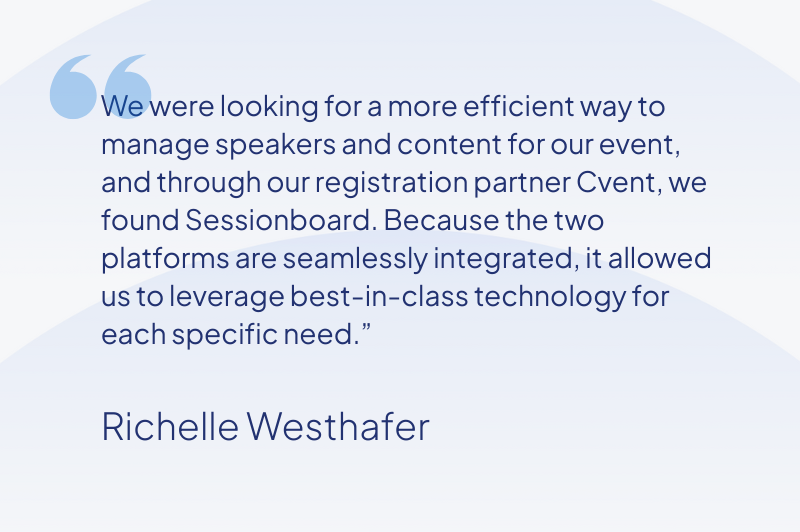
As the team built the business case, something became clear:
a tool introduced for one event could unlock a strategic lever across the entire marketing ecosystem.
With Sessionboard in place, Docebo reframed how they think about speakers entirely.
Instead of asking:
“Who can speak at this event?”
They now ask:
“Who are our experts—and how do we activate them intentionally across everything we do?”
Sessionboard enabled Docebo to:
Most importantly, it created a shared system of record for brand voices—something that had never existed before.
Today, Sessionboard is live for Inspire and already delivering value by:
This has allowed the team to move faster, reduce friction, and deliver a more consistent, professional speaker experience—without increasing operational complexity.
Over the coming months, Docebo plans to expand this approach into a holistic speaker ecosystem across all of marketing.
The goal is simple:
This includes:
By treating speakers as a long-term asset—not a per-event task—Docebo is building infrastructure that scales with the business.
As Docebo expanded its speaker ecosystem, one capability became especially critical: the ability to treat expertise as searchable, reusable infrastructure.
With Sessionboard acting as a true Speaker CRM, the team can:
Once a speaker is selected, activation is seamless.
Speakers, sessions, and presentations are managed in Sessionboard—and when a speaker is added to an event, everything automatically syncs to Cvent.
Just as importantly:
is automatically reflected in Cvent in real time.
This eliminates duplicate work, reduces errors, and creates a single source of truth across platforms—allowing teams to focus on strategy instead of reconciliation.
Richelle credits much of this success to the philosophy behind the integration itself.
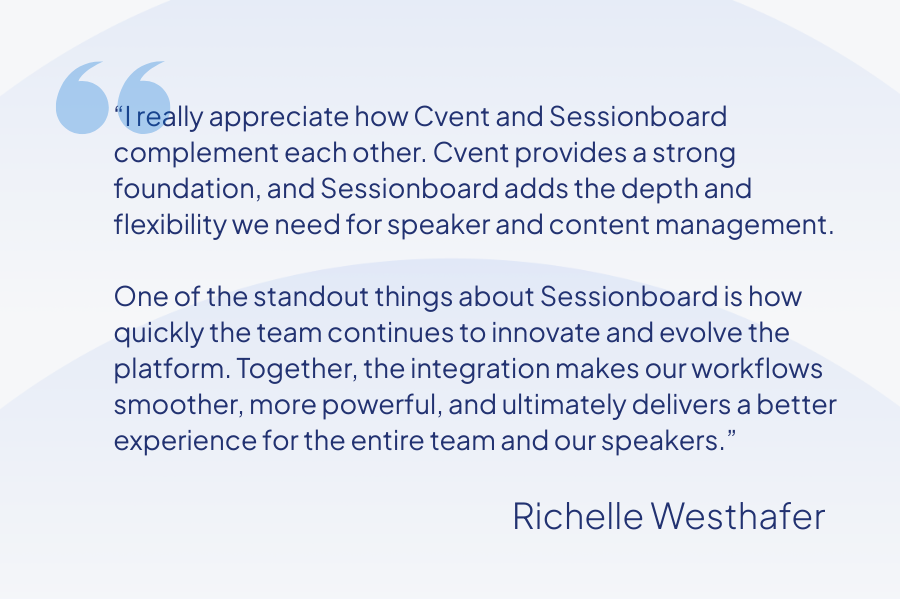
Rather than forcing marketing teams into a single, monolithic system, Docebo benefits from a best-in-class ecosystem:
Together, they enable speed, flexibility, and continuous innovation—without compromise.
When asked what she’d tell teams considering Sessionboard, Richelle’s answer is simple:
Yes, it solves the immediate problem of managing speakers and content more efficiently.
But the real value is strategic.
It changes how marketing teams think about expertise, credibility, and activation across the entire go-to-market motion.
When speakers feel prepared, supported, and genuinely valued, they don’t just participate—they elevate everything around them.
Docebo’s story reflects a broader shift in modern B2B marketing:
By operationalizing speaker management with the right systems—and pairing best-in-class platforms through thoughtful integration—Docebo turned a historically manual function into a core marketing asset.
And in doing so, they created a repeatable model for how modern marketing teams can scale trusted, human-centered content.
.png)

Stay up to date with our latest news
See how real teams simplify speaker management, scale content operations, and run smoother events with Sessionboard.
